


Executive Summary: International founders can manage US LLC compliance fully remotely by combining five things: a registered agent, a digital document vault, a compliance calendar, cloud bookkeeping, and one accountable human who watches it all. No US visit required. No US accountant on payroll. No office. GenZone clients in 50+ countries run their entire US compliance this way, from a phone, usually over WhatsApp.
In 2026, forming a US LLC from abroad is the easy part. Truly. A founder in Lagos, Delhi, or Dubai can go from idea to a fully formed Wyoming LLC with an EIN in about a week, without ever seeing a US airport.
Then the formation service goes quiet. And the founder is left holding a US company, with US deadlines, US mail, and US penalties, from eleven time zones away.
That is the actual problem. Not compliance itself. Distance.
We have already published a complete breakdown of every filing a non-resident LLC owner is responsible for, covering federal, state, and situational obligations, in our detailed guide to US LLC annual filings and compliance. This article is not that. This article answers the question that comes right after: fine, I know what needs to be filed, but how do I actually run all of this from another continent, without living in fear of a letter I will never see?
At GenZone, we have helped 1,100+ founders from more than 50 countries form and operate US entities remotely. Not one of them has ever needed to visit the United States for compliance. Here is the system that makes that possible.
The Real Problem Isn’t Compliance. It’s Distance.
Think about how a US-based business owner handles compliance. Their registered agent forwards mail to an address down the street. Their accountant is a phone call away, in the same time zone. Every April, the entire country reminds them it’s tax season. Compliance is ambient. It’s in the air.
Now remove all of that.
You’re in Dubai. It’s 6pm your time, 9am in Wyoming. A state notice was mailed three weeks ago to an address you’ve never physically visited. Your home country has no April 15. Nobody around you has ever heard of Form 5472. There is no ambient reminder system. There is only you, and whatever structure you deliberately built.
That’s why remote compliance failures almost never happen because a founder was careless. They happen because the founder was absent from the environment where compliance signals live.
The fix isn’t working harder. It’s building a system that brings those signals to you.
The Four Places Remote Compliance Breaks Down
After managing compliance for founders across 50+ countries, we can tell you exactly where it goes wrong. It’s almost always one of four failure points.
1. Physical mail blindness. Your LLC has a US address, which belongs to your registered agent. The state writes to it. Sometimes the IRS writes to it. If nobody is scanning, forwarding, and flagging that mail, official notices pile up unread. We’ve onboarded founders who discovered months-old dissolution warnings sitting in an inbox they didn’t know existed.
2. Deadline drift. US deadlines don’t announce themselves abroad. Your Wyoming annual report is due in your formation anniversary month, a date with zero emotional weight to you. Federal deadlines land in April, when your own country’s tax calendar might be pointing somewhere else entirely. Without a system, deadlines don’t get missed dramatically. They just… drift past.
3. Document scatter. Articles of Organization in one email thread. EIN letter in another. Operating agreement in a WhatsApp chat with a provider who no longer replies. Then Stripe runs a routine account review and gives you 48 hours to produce all three. Remote founders don’t lose documents. They lose the ability to find them fast, and with payment processors, fast is the whole game.
4. Invisible change events. You add a co-founder. You move countries. You change your business address. Each of these quietly triggers filings. Ownership changes alone can convert your entire federal filing structure, as we cover in Section 6 of our filings guide.
A founder in the US might hear this from their accountant over coffee. A founder in Karachi hears it from nobody, unless someone is actively watching their entity.
Every remote compliance system worth having is really just an answer to these four problems.
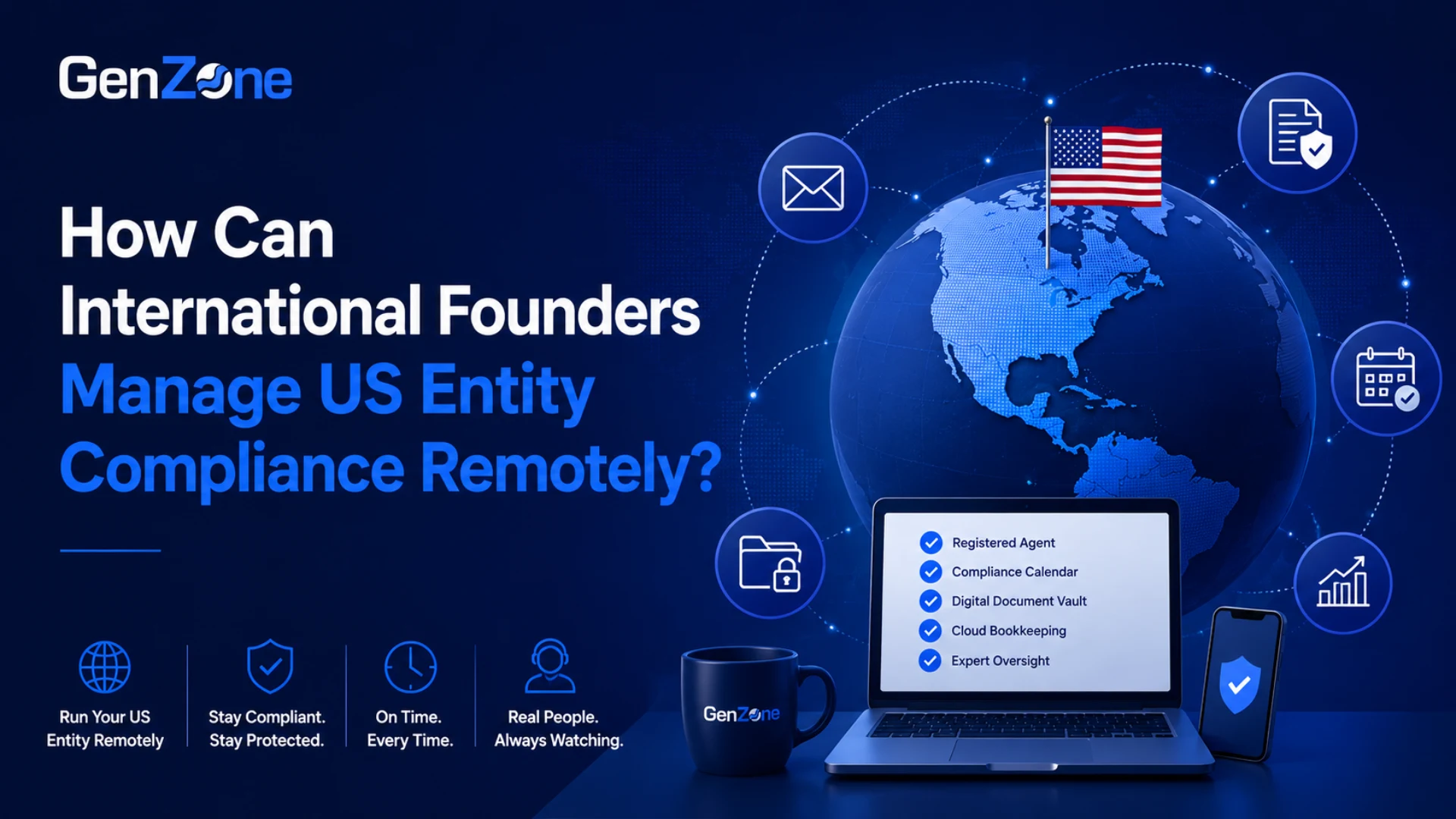
The Remote Compliance Stack: Five Components
Here is what actually works. Not in theory, but in practice, across a thousand-plus entities we manage.
1. A Registered Agent That Acts Like Your US Nervous System
Most founders think of the registered agent as a legal checkbox. That’s a mistake. Done properly, your registered agent is your physical presence in the United States, the eyes and hands you don’t have.
The baseline service receives official mail. The version you actually need scans it same-day, forwards it digitally, and flags what’s urgent. The difference sounds small. It’s the difference between learning about a state notice in hours versus learning about it after your LLC has been administratively dissolved and your Stripe account frozen.
Every GenZone formation includes registered agent service with automatic renewal, because a lapsed agent is one of the fastest routes to involuntary dissolution, and it’s entirely preventable.
2. A Digital Document Vault
One place. Every core document. Retrievable in under a minute, from any device, in any country.
At minimum: Articles of Organization, Operating Agreement, IRS EIN Confirmation Letter, BOI filing confirmation, past annual reports, and past federal filings. These are the documents banks, payment processors, and the IRS ask for, usually without warning, and usually with a deadline.
The test is simple. If Mercury emailed you right now asking for your operating agreement and EIN letter, could you respond within the hour? If the answer involves searching old email threads, you don’t have a vault. You have scatter.
3. A Living Compliance Calendar
Your US entity has two kinds of deadlines: fixed-date obligations (federal filings in March or April, certain state reports) and anniversary-based obligations (Wyoming’s annual report, registered agent renewal). Both need to live in a calendar you actually look at, with reminders set 60 and 30 days out, not the night before.
Build it once, at formation. Then treat it as living: every business change gets checked against it. This is thirty minutes of setup that prevents the two most expensive words in non-resident compliance, which are “I forgot.”
4. Cloud Bookkeeping From Day One
Here’s a truth most formation services won’t say out loud: for a remote founder, reconstructing a year of books is roughly ten times harder than maintaining them monthly. You’re not down the street from your bank. You can’t walk into a branch. Statements, invoices, and transfers pile up across platforms and currencies, and untangling them retroactively, from abroad, at filing time, is miserable.
Cloud accounting from day one, reconciled monthly, solves this quietly. It also does something founders underestimate: it keeps a clean wall between LLC money and personal money, which protects both your liability shield and your standing with payment processors.
5. One Accountable Human
This is the component the industry doesn’t want to sell you, because humans don’t scale like software.
When you’re nine hours offset from the US and something urgent lands, whether that’s a bank freeze, an IRS letter, or a processor review, a ticket queue is not support. It’s a waiting room. What a remote founder needs is one named person who knows their entity, answers across time zones, and takes ownership rather than escalating you into the void.
This is why every GenZone client gets a dedicated relationship manager on WhatsApp, available 24/7. Not a chatbot wearing a human name. A person who knows your file. Our clients tell us this single feature is the reason remote compliance stops feeling like a risk and starts feeling boring, which is exactly what compliance should feel like.
What You Must Do Yourself vs What You Can Fully Delegate
Remote doesn’t mean hands-off. It means knowing precisely which hands do what.
| You must personally handle | You can fully delegate |
|---|---|
| Signing documents and approving filings before submission | Registered agent service and annual renewal |
| Reporting ownership changes the moment they happen | State annual report preparation and filing |
| Reporting address or country-of-residence changes | Federal filing preparation and submission |
| Keeping LLC and personal funds separate | BOI report updates |
| Making final business decisions | Monthly bookkeeping and reconciliation |
| Reading what your compliance partner flags as urgent | Mail monitoring, scanning, and deadline tracking |
Notice the pattern. Everything on the left takes minutes and requires you, your signature, and your knowledge of your own life. Everything on the right takes hours, requires US-side infrastructure, and requires none of your presence. A well-run remote entity is one where the founder’s total compliance workload is measured in minutes per month.
A Year in the Life of a Remotely Managed LLC
Here’s what the rhythm actually looks like once the system is running. Assume a single-member Wyoming LLC owned by a founder abroad.
Every month: Books reconciled in the cloud. Fifteen minutes of your attention, or zero if it’s delegated. Registered agent mail reviewed as it’s scanned.
January to February: Year-end handoff. Your bookkeeping, clean because it was maintained monthly, goes to whoever prepares your federal filings. No reconstruction. No panic.
March to April: Federal filing season. Your annual IRS obligations get prepared, sent to you for review and signature, and submitted. Which forms, exactly, depends on your structure, and our filings guide covers every scenario. You approve from your phone. Done.
Your anniversary month: Wyoming annual report filed. Registered agent renewed. If nobody told you which month this is, that’s a red flag about your current provider.
Whenever life changes: New co-founder, new country, new address. You send one message, and the downstream filings get triggered by someone whose job it is to know what those changes mean. A client relocating from India to the UAE, for instance, may need their W-8BEN-E position revisited, the kind of detail nobody catches unless somebody is watching.
That’s it. That’s the whole year. Unremarkable by design.
How GenZone Built This For Remote Founders Specifically
Most formation services were built for Americans, then marketed to everyone else. GenZone was built backwards from the remote founder, because our own founders were remote founders, running international structures from Dubai before GenZone ever existed.
That origin shows up in the details. Our team operates from Dubai and Miami, which means we cover time zones from Asia-Pacific through the Americas without anyone waiting overnight for a reply.
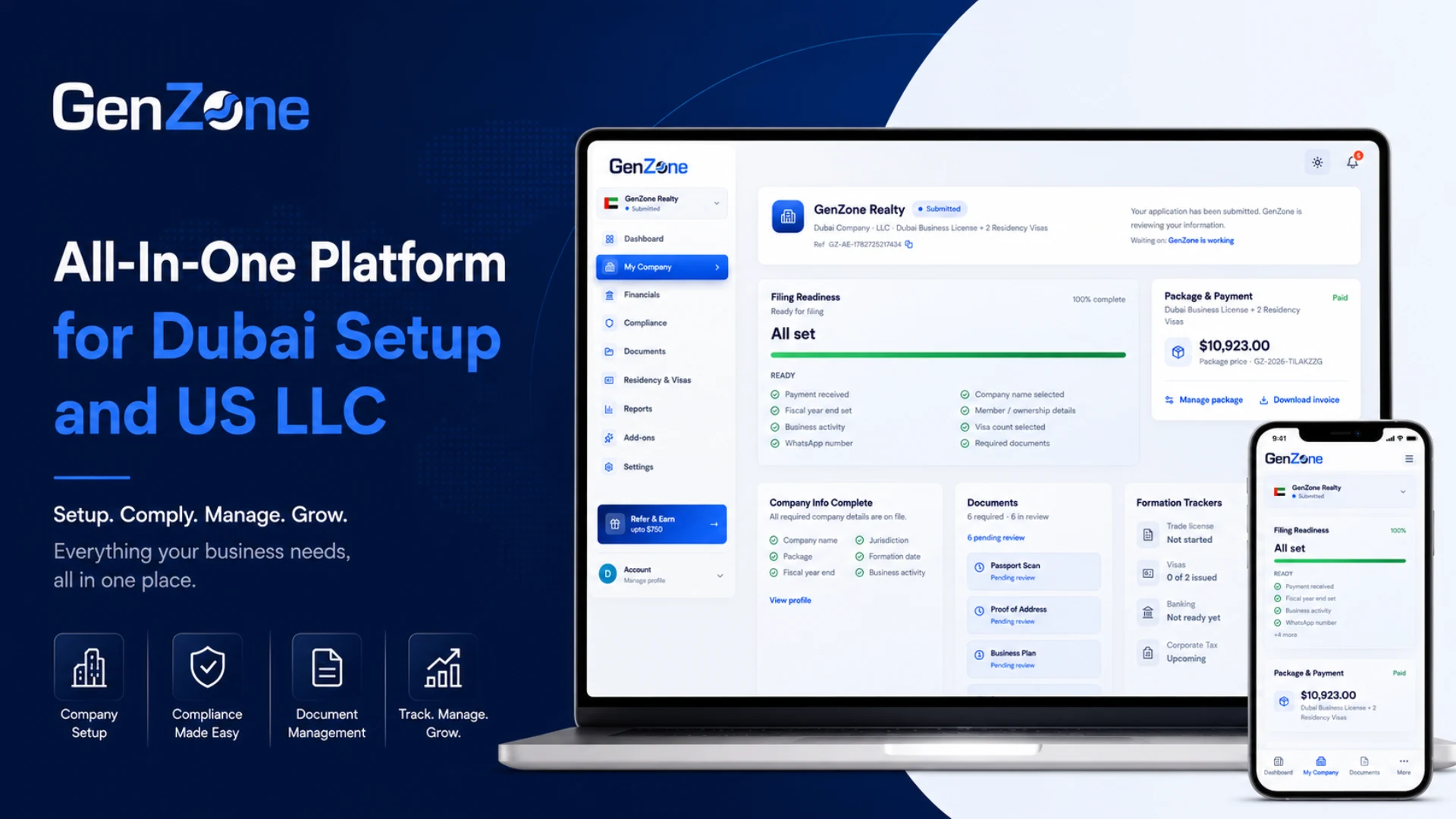
Our client platform, GenZone LaunchPad, gives every founder a single dashboard where their documents, filings, and deadlines live. The vault and the calendar, already built. And the relationship manager model means compliance reminders come to you, proactively, instead of waiting for you to remember to ask.
One more thing, because it’s the situation we encounter most often:
If you already have a US LLC, formed with another provider, you don’t need to start over. The most common message we receive isn’t “help me form a company.” It’s “I formed my LLC with an online service last year, they’ve gone quiet, and I have no idea what I’ve missed.”
Our renewal and takeover plans exist for exactly this. We audit where your entity stands, catch up what’s behind, and take over the full compliance stack from that point forward: agent, filings, banking support, and bookkeeping if you want it. No gaps, no judgment.
The Mistakes Remote Founders Keep Making
A few patterns we see often enough that they deserve their own warnings. These are operational mistakes, different from the belief-level myths that stop founders before they start.
Using the registered agent address as a business address. It isn’t one. Putting it on invoices, bank applications, and platform accounts creates verification problems and can violate your agent agreement.
Ignoring scanned mail because “it’s probably nothing.” State notices escalate on a schedule. The third letter is rarely as polite as the first.
Running LLC expenses through personal foreign cards. It feels harmless. It slowly corrodes your liability protection, muddies your books, and gives payment processors a reason to look harder at you.
Moving countries without telling anyone. Your country of tax residence shapes your treaty position and your withholding paperwork. Relocating without updating it means your compliance is quietly wrong until someone notices.
Assuming silence means safety. The IRS does not send a friendly annual “you’re all good!” note. No news is not good news. No news is just no news, and sometimes it means the news went to an address nobody was watching.
Frequently Asked Questions
Can I really manage a US LLC 100% remotely, forever?
Yes. There is no US law requiring an LLC owner to visit the country, hold meetings on US soil, or maintain a physical office. What the law requires is a registered agent with a US address and up-to-date filings, both of which can be handled entirely on your behalf. GenZone clients have run US entities remotely for years without a single trip
Do I need to hire a US accountant?
Not in the traditional sense. What you need is US-competent filing support from someone who understands non-resident obligations specifically, which many general US accountants rarely encounter. A managed compliance service purpose-built for non-residents typically costs less than a US CPA and covers more of the actual workflow: mail, deadlines, state filings, and federal submissions in one place.
What happens to my compliance if I move to another country?
Your LLC itself doesn’t change, but your personal tax position might. Country of residence affects treaty claims and the certification forms you give US clients. The rule is simple: report any relocation to whoever manages your compliance immediately, and let them assess what needs updating. It’s usually a small adjustment. Unreported, it becomes a quiet error that compounds.
How do I receive IRS or state letters if I live abroad?
Through your registered agent, which is exactly why agent quality matters more for remote founders than for anyone else. Choose a service that scans and forwards mail digitally the day it arrives, with urgent items flagged. GenZone includes this in every package, so official correspondence reaches your phone within hours, not weeks.
My LLC was formed by another provider. Can GenZone take over its compliance?
Yes, and this is one of the most common ways founders come to us. Our renewal plans are built as compliance takeovers: we review your entity’s current standing, identify anything overdue, bring it current, and manage everything going forward, including registered agent, state reports, federal filings, banking support, and optional bookkeeping. You don’t need to re-form anything.
The Bottom Line
Managing a US entity from abroad is not hard. Managing it without a system is nearly impossible, and the founders who get burned are almost never lazy or careless. They’re just alone, far away, with no structure carrying the signals to them.
The stack is five pieces: an agent that watches, a vault that holds, a calendar that reminds, books that stay clean, and a human who answers. Build it yourself if you like. Or use ours. It’s already running for founders in more than 50 countries, and it works whether we formed your LLC or someone else did.
Your business shouldn’t need you to be in America. It just needs someone there who’s paying attention.
Book a Free Consultation Call, for a new US LLC or a compliance takeover of your existing one