




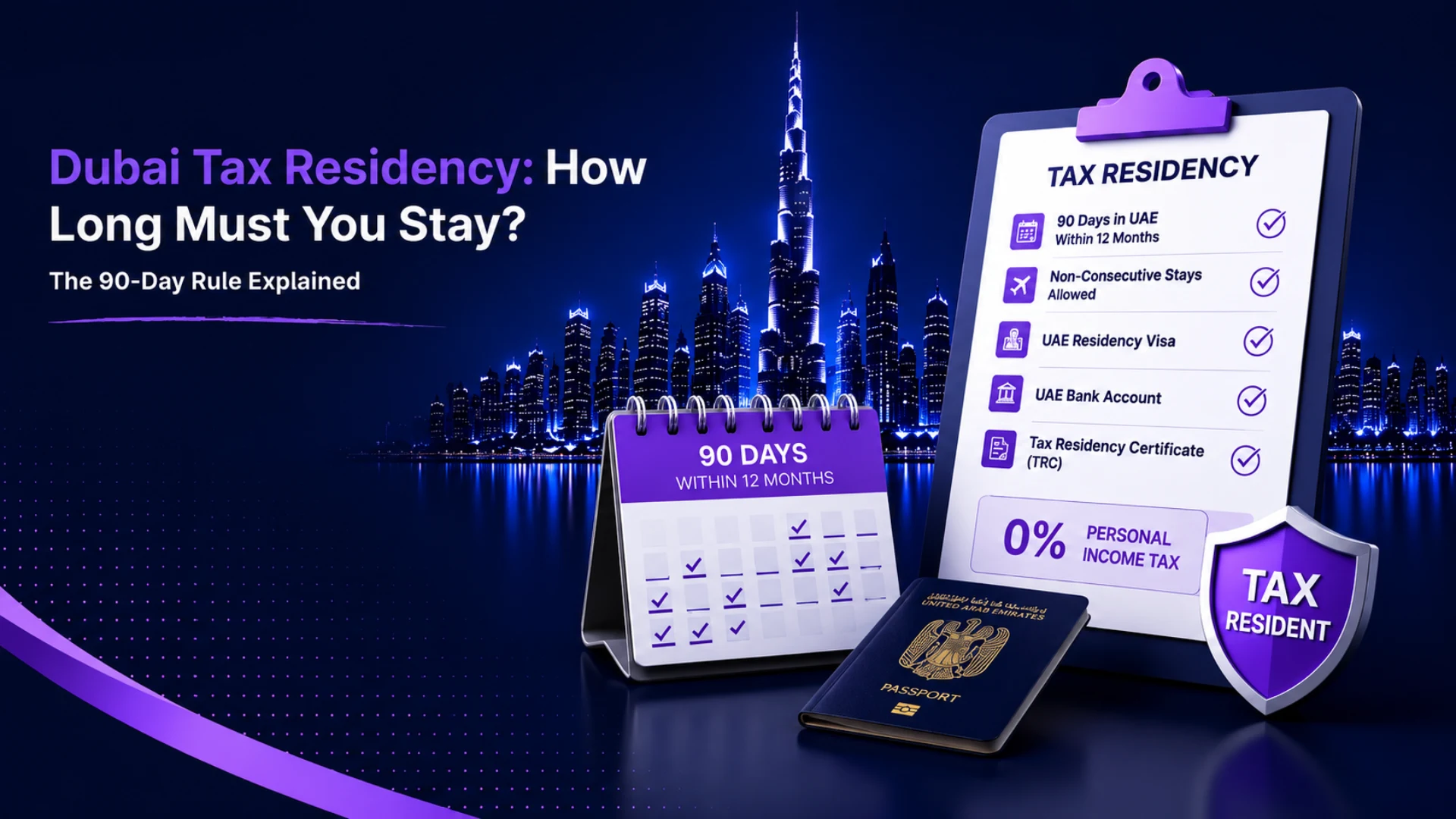
Executive Summary: The UAE reduced its tax residency threshold from 183 days to 90 days in March 2023. Days do not need to be consecutive, and any Emirates counts, not just Dubai. The 90-day threshold qualifies you for a domestic Tax Residency Certificate, sufficient for most founders. The international TRC requires 183 days and is only needed for specific treaty situations. Critically, meeting the UAE threshold does not automatically end tax residency in your home country. Both sides must be handled correctly.
At GenZone we speak with thousands of people every year who are seriously considering Dubai. The question that comes up more than almost any other is not “is the 0% tax real?” People know it is real by the time they call us. The question is more specific: “How long do you have to live in Dubai for tax free income?” Or more precisely: “I do not want to live in Dubai full time. How many days do I actually need to be there?”
It is a precise question and it deserves a precise answer. Most articles give you a number and stop there. This one gives you the full picture: what the number actually means, what it gets you, why it is not enough on its own, how your home country factors in, how to count days correctly, what the Tax Residency Certificate application actually involves, and what causes rejections.
If you want to understand how Dubai’s 0% tax works in principle first, read 0% Tax in Dubai: The Complete Blueprint. If you want to understand visa pathways and life setup, read the Dubai Residency Guide. This article is specifically about time, presence, and tax residency mechanics.
How Long Do You Really Need to Stay in Dubai to Pay 0% Tax?
The answer changed in March 2023. But the day count is only half the picture. Here is the complete guide to what the number actually means.
- Standard UAE Tax Residency Certificate
- Accepted by banks, financial institutions, and most foreign tax authorities
- Sufficient for UK, Canada, Australia, South Africa, and most of Europe
- GenZone has a 100% approval rate on TRC applications
- Needed for invoking specific double tax treaty provisions
- Relevant for complex multi-jurisdiction income sources
- Applies when home country makes an aggressive non-residency challenge
- Most founders do not need this – check with your advisor
The Short Answer: 90 Days
In March 2023, the UAE updated its tax residency rules through a Ministerial Decision. The physical presence threshold for UAE tax residency was reduced from 183 days to 90 days per year. Days do not need to be consecutive. They do not need to fall in any particular months. They just need to total 90 within a 12-month period.
This was a deliberate policy decision. The UAE recognised that the 183-day rule was excluding a large segment of internationally mobile entrepreneurs and investors who wanted to establish genuine ties to the UAE but could not or did not want to commit to six months per year. The 90-day threshold opened the door to a much wider group while still maintaining a meaningful presence requirement.
So the minimum is 90 days. But as we will cover in detail below, the number is only one part of the equation.
Residency vs Tax Residency: A Distinction That Matters
Before going further, there is a distinction that catches many people out and it is worth being direct about it.
A UAE residency visa is a document that gives you the legal right to live and work in the UAE. It is issued by a company you own or an employer. It has a minimum renewal requirement: you must enter the UAE at least once every 6 months to keep the visa active. One day every 6 months is the visa maintenance threshold.
UAE tax residency is an entirely separate concept. It is the formal status recognised by the UAE’s Federal Tax Authority (FTA) that designates you as a UAE tax resident, which is what unlocks the 0% personal income tax benefit. It requires a minimum of 90 days of physical presence per year and the formal application for a Tax Residency Certificate (TRC).
One day every 6 months keeps your visa alive. It does not make you a UAE tax resident. These are two completely different thresholds serving two completely different purposes. Confusing them is the single most common misconception we encounter.
The Two TRC Thresholds and When Each Applies
There are two versions of the UAE Tax Residency Certificate, and which one you need depends on your specific situation.
Domestic TRC: 90 Days
The domestic Tax Residency Certificate is what the vast majority of people relocating to Dubai need. It is issued by the FTA once you have met the 90-day presence threshold and submitted the required documentation. It is accepted by banks, financial institutions, and tax authorities for confirming UAE tax resident status, and it is what you present when you are demonstrating that you are no longer tax resident in your country of origin.
For most GenZone clients from Canada, the UK, Australia, New Zealand, South Africa, and most of Europe, the domestic TRC is entirely sufficient. It is the standard certification and it does the job.
International TRC: 183 Days
The international TRC requires 183 or more days of physical presence in the UAE per year. It is specifically relevant for people who need to invoke specific provisions under the UAE’s double tax treaties, formal bilateral agreements the UAE has signed with over 130 countries that determine taxing rights between jurisdictions.
The international TRC is not something most people need to think about. It becomes relevant in specific scenarios: when your home country’s tax authority is challenging your non-residency status under a treaty provision, when you are dealing with complex multi-jurisdiction income sources, or when a specific treaty article requires the higher presence threshold to be invoked. If you are unsure whether you need the international certificate, it is worth raising with a specialist before assuming you do.
For the purposes of most people reading this guide, the domestic 90-day TRC is the target.
What Counts as a Day in the UAE
Day counting sounds simple but the details matter, particularly if you are managing your presence carefully across multiple countries.
Any day where you are physically present in the UAE counts. This includes arrival days and departure days. If you land in Dubai at 11pm on a Monday, Monday counts. If you depart on a Thursday morning, Thursday counts.
Days must involve physically entering the UAE. Time spent in UAE transit zones without passing through immigration does not count. If you have a connecting flight in Dubai but never clear customs and immigration, those hours do not contribute to your day count.
The 12-month period is a rolling window. The UAE uses a 12-month taxable period rather than a fixed calendar year. This means you are not calculating days from January 1 to December 31 specifically. You are tracking any consecutive 12-month stretch. In practice, most people align their presence tracking with their TRC application date.
Hospitalisation days can count in certain circumstances, specifically if you are admitted to a UAE hospital during what would otherwise be a planned visit. This is a nuance worth knowing but not something to plan around.
Days in other Emirates count. The UAE includes Abu Dhabi, Dubai, Sharjah, Ras Al Khaimah, Fujairah, Ajman, and Umm Al Quwain. Any day physically present in any of these seven Emirates counts toward your UAE presence threshold. You do not need to be in Dubai specifically.

What 90 Days Actually Looks Like in Practice
One concern people often have is whether 90 days per year is manageable alongside an internationally mobile lifestyle. In practice, it is quite flexible. Here are three examples of how the same 90 days can be structured very differently:
The three-month block. Spend January, February, and March in Dubai. Then travel freely for the remaining nine months. This is the simplest approach and suits people who prefer extended stays over frequent travel.
The fortnightly sprint. Visit Dubai for two weeks every two months. Six visits across the year, 14 days each, totals 84 days. Add a few extra days to one or two trips and you reach 90 comfortably. This suits people who need to move frequently for business or personal reasons.
Front and back loading. Spend 30 days in January, 30 days in May or June, and 30 days in November or December. Three separate trips, different parts of the year, 90 days total. This suits people with strong seasonal commitments elsewhere.
The point is that the non-consecutive nature of the 90-day rule gives you genuine flexibility. You are not forced to live in Dubai. You are required to be there, in aggregate, for a quarter of the year.
Why 90 Days in Dubai Is Not Enough on Its Own
This is the piece that most day-count articles skip entirely, and it is arguably the most important part.
Meeting the UAE’s 90-day requirement handles your position in the UAE. It does not handle your position in your home country. Your home country’s tax authority is asking a completely separate question: when did you stop being a tax resident of our country? And the answer depends entirely on that country’s own rules.
You can be a fully documented UAE tax resident with a valid TRC and still be considered a tax resident of Canada, Australia, the UK, or Germany if you have not taken the correct steps to exit their tax system. This is how people end up paying tax in two jurisdictions simultaneously, and it is entirely avoidable with proper planning.
Every country has its own exit criteria. Here is how the major ones work.
Canada
Canada uses a combination of physical presence and residential ties. The Canadian Revenue Agency (CRA) looks at whether you still maintain a home available to you in Canada, whether your spouse or common-law partner remains in Canada, whether your dependants remain in Canada, and whether you maintain significant personal property and social ties.
Simply leaving Canada and spending 91 days in Dubai does not exit you from Canadian tax residency if your spouse still lives in Toronto, your house is available for your return, and you have Canadian bank accounts, club memberships, and vehicles. The CRA takes a totality-of-ties approach rather than a pure day count.
Properly exiting Canadian tax residency involves severing residential ties, filing a T1161 (list of properties) and a final departure return (T1), and in some cases dealing with Canada’s departure tax on deemed dispositions of assets. The case of the Canadian CEO who paid $1.5M in annual taxes before moving to Dubai illustrates both the scale of the opportunity and the importance of doing the exit correctly.
Our guide on why Canadians are moving to Dubai covers the relocation picture in full.
United Kingdom
The UK uses the Statutory Residence Test (SRT), a structured framework that looks at UK day counts alongside a set of “ties” including UK accommodation, family ties, work ties, and a 90-day tie (for people who spent more than 90 days in the UK in either of the two preceding tax years).
The number of days you can spend in the UK without being UK tax resident depends on how many ties you have. The fewer ties, the more days you can spend in the UK while remaining non-resident. The UK tax year runs April 6 to April 5, and the year of departure typically involves split-year treatment, meaning you are UK resident for part of the year and non-resident for the remainder.
The practical implication: if you move to Dubai mid-year, properly structured, your UK tax liability ends partway through the tax year. If you do not structure it correctly, HMRC may treat you as UK resident for the full year. The full process for UK founders is covered in our moving to Dubai from the UK guide.
Australia
Australia has one of the most aggressive and complex tax residency exit tests in the world. The Australian Tax Office (ATO) uses a “resides” test supplemented by statutory tests including a domicile test that can maintain Australian tax residency for years after departure if Australia is still considered your “permanent place of abode.”
Australians who sell assets before leaving may also face capital gains tax implications, as Australia taxes gains on many asset types on departure. This is compounded by Australia’s exit tax on unrealised gains in certain structures. We covered Australia’s exit tax on unrealised gains and what it means for investors considering the move.
Australians need country-specific tax residency exit advice before relocating. This is not optional. Getting it wrong has serious and costly consequences.
Germany and the Netherlands
Germany uses a concept of “Wohnsitz” (place of abode) and “gewöhnlicher Aufenthalt” (habitual residence). If you maintain a registered address in Germany or habitually stay there, Germany may continue to treat you as a tax resident regardless of where you spend the majority of your time.
The Netherlands introduced an unrealised gains tax on departure that can create a significant liability at the point of exit, particularly for founders holding substantial equity in their businesses. The Dutch unrealised gains tax and how investors are responding is covered in detail in our dedicated article.
Both countries require formal deregistration from the national tax system, not just a physical move, before exit from domestic tax residency takes effect.
United States
The US is in a category of its own. US citizens and green card holders are taxed on their worldwide income regardless of where they live, how long they have been abroad, or how many days they spend in Dubai. A UAE residency visa and TRC do not change US tax obligations.
For US citizens, the UAE structure can still be valuable in specific configurations, particularly around corporate structures and deferral mechanisms. But eliminating US tax obligations entirely requires either renouncing citizenship or formally abandoning a green card, both of which carry significant consequences and require specialist legal advice. If you are American and exploring Dubai, start with a US international tax specialist before anything else.

The Three-Tier Presence Framework
It helps to think about UAE presence in three tiers rather than a single threshold.
Tier 1: 90 days, domestic TRC. You qualify for the standard UAE Tax Residency Certificate. This is sufficient for the vast majority of internationally mobile entrepreneurs. You are formally a UAE tax resident and have the documentation to prove it.
Tier 2: 183 days, international TRC. You qualify for the more authoritative international certificate. This is relevant for invoking specific treaty provisions and for people whose home country takes an aggressive position on non-residency challenges.
Tier 3: 183 or more days, primary residence. Your centre of life is demonstrably in the UAE. This satisfies even the most aggressive home-country tests, including Australia’s domicile test and Germany’s habitual residence standard. At this level, the UAE is unambiguously your primary home.
Most people who relocate to Dubai through GenZone operate comfortably in Tier 1. Some, particularly those with Australian or German backgrounds or complex multi-jurisdiction situations, aim for Tier 2 or 3 on the advice of their home-country tax specialist.
The Tax Residency Certificate Application: What It Actually Involves
The TRC is applied for through the UAE Federal Tax Authority’s online portal. Here is what the application requires and what makes the difference between approval and rejection.
What You Need Before Applying
You must have a valid UAE residency visa at the time of application. The visa cannot be expired or under renewal. You need to have met the 90-day physical presence threshold within the 12-month period you are certifying. And you need a UAE bank account showing regular transactional activity during the period.
The Documentation Package
The FTA requires:
- Passport copy with UAE entry and exit stamps covering the period
- Emirates ID copy
- Valid UAE residency visa copy
- UAE bank statements showing transactions during the period
- Tenancy contract or title deed for UAE accommodation (if applicable)
- Company trade licence (if your residency is company-based)
- Completed FTA online application form with supporting period declarations
What Gets Applications Rejected
GenZone has a 100% TRC approval rate. The rejections we see, invariably from people who applied without proper guidance, tend to come from three sources.
Insufficient presence documentation. Passport stamps alone are sometimes not enough, particularly if your travel was frequent and the stamps are spread across multiple pages or multiple passports. Entry and exit records from the UAE General Directorate of Residency and Foreigners Affairs (GDRFA) can be obtained to supplement passport evidence.
Bank account showing no meaningful activity. A UAE account opened six months ago with two transactions and no regular usage is a weak economic substance signal. The FTA is looking for evidence that you genuinely live and operate from the UAE. Regular transactions, consistent use, and ideally both personal and business account activity strengthen the case.
Mismatch between declared days and documented evidence. If you claim 95 days but the documentation supports 88, the application is likely to be queried or rejected. Count carefully, document thoroughly, and apply with a buffer above the minimum.
Processing Time and Validity
TRC applications typically process within 5 to 10 business days once the complete documentation is submitted. The certificate covers the 12-month period it is applied for and must be renewed annually. GenZone handles TRC applications for all clients on ongoing compliance packages, including documentation preparation and FTA liaison.
Practical Tips for Managing Your Presence
If you are structuring your year around the 90-day requirement and want to stay as mobile as possible, here is what we recommend based on working with hundreds of clients who do exactly this.
Build in a buffer. 90 days is the minimum. Most clients aim for 100 to 120. A missed flight, an early departure for a family situation, a miscounted day, these things happen. A 10 to 30 day buffer protects you without significantly affecting your mobility.
Track from the day you land. Do not rely on memory. Keep a dedicated calendar or spreadsheet logging every UAE entry and exit date. Use passport stamps as your primary record and supplement with flight booking confirmations, hotel receipts, and credit card statements showing UAE transactions.
Gather supporting evidence throughout the year. Do not wait until you are applying for the TRC to start documenting your presence. Keep a consistent trail: UAE bank transactions, utility bills or rent receipts, local phone usage records, and any professional engagement records from time spent in Dubai.
Apply for the TRC as soon as you hit 90 days. Do not wait until the end of the year. Once you have met the threshold and have the documentation to support it, apply. Having the certificate in hand is far stronger than counting days on a spreadsheet.
Coordinate your day count across jurisdictions. If you are managing presence carefully in multiple countries, a simple spreadsheet tracking days per country per rolling 12-month period will prevent surprises. You want to hit 90 in the UAE and stay below triggering thresholds everywhere else.
A Worked Example
Sarah is a UK-based consultant earning £280,000 per year. She pays roughly £126,000 in income tax and National Insurance. She wants to move to Dubai but cannot fully leave the UK, as she has family commitments there.
What she does on the UAE side:
She sets up a free zone company and obtains her 2-year residency visa. She structures her year so she spends 45 days in Dubai in Q1, 30 days in Q2, and 30 days in Q4, totalling 105 days. She applies for her domestic TRC in Q4.
What she does on the UK side:
She consults a UK non-domicile specialist before leaving. Under the SRT, she needs to count her UK ties and determine how many days she can spend in the UK while remaining non-resident. With her Emirates ID, UAE company, and UAE bank account established, she has strong evidence of shifted economic centre. She files for split-year treatment for the year of departure and is treated as UK non-resident from the date she left.
The result: She pays 0% UAE personal income tax on her consulting income. Her effective tax rate drops from approximately 45% to the cost of maintaining her UAE structure, roughly AED 15,000 to AED 20,000 per year. Over five years, the difference runs into the hundreds of thousands of pounds.
Getting both sides right is what makes it work. Getting only the UAE side right without properly exiting the UK would leave her paying UK tax regardless of the TRC she holds.
Frequently Asked Questions
Does the 90 days have to be in Dubai specifically?
No. Any day spent anywhere in the UAE counts, including Abu Dhabi, Sharjah, Ras Al Khaimah, and the other Emirates.
Do arrival and departure days both count?
Yes. Both the day you arrive and the day you depart count as UAE days.
Can I apply for the TRC myself?
Yes, the FTA application is online and technically open to individuals. The issue is documentation quality and completeness. Applications with gaps or inconsistencies are queried or rejected. GenZone handles TRC applications as part of ongoing compliance packages and has not had a single rejection.
What if I miss the 90-day threshold one year?
You cannot obtain or renew the TRC for that period. If your home country’s tax authority is actively monitoring your status, a year without a valid TRC is a vulnerability. Most clients budget their presence to avoid this.
How does the TRC interact with my home country’s tax rules?
The TRC is evidence of UAE tax residency, not a guarantee that your home country accepts your non-residency claim. Your home country applies its own exit and tie-breaking rules. In some cases the TRC is directly required by treaty provisions. In others it is supporting evidence alongside other documentation. Your home-country tax adviser will tell you exactly how it applies in your situation.
Do I need the international TRC or the domestic TRC?
For most people, the domestic 90-day TRC is sufficient. The international 183-day TRC is for specific treaty invocations and complex multi-jurisdiction situations. If you are unsure, raise it during your GenZone strategy call.
How long do you have to live in Dubai for tax free income?
You don’t need to live there full time. Since 2023, just 90 days per year qualifies you for UAE tax residency and 0% personal income tax.
