








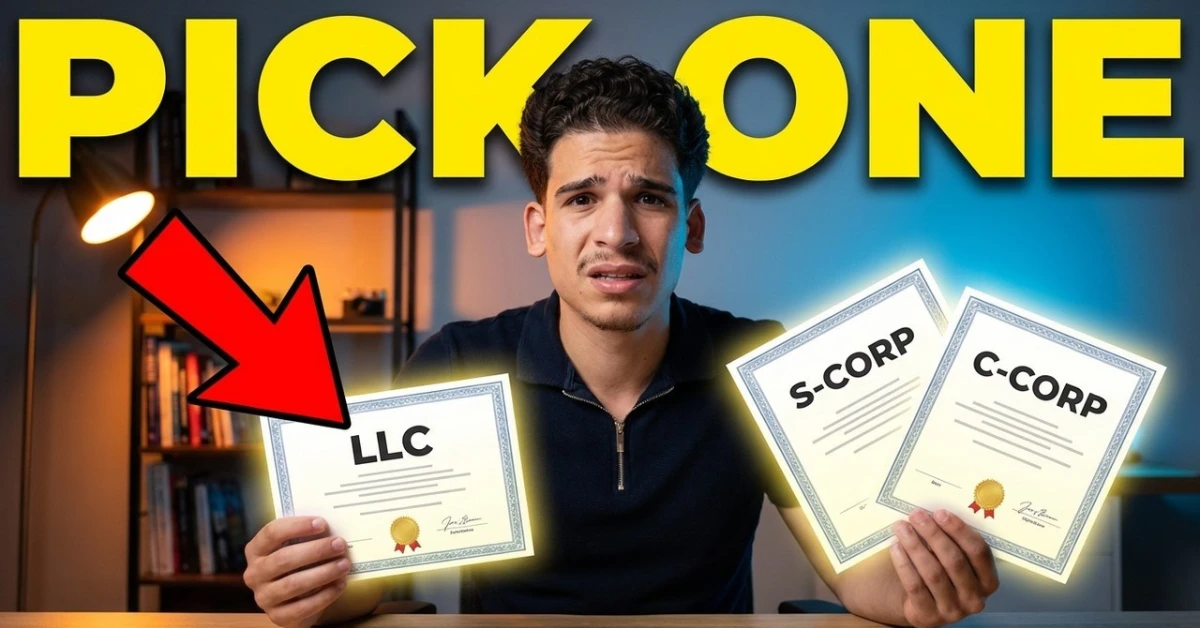
If you’re starting a business in the US as a non-resident, you’ve probably heard these three names thrown around – LLC, S-Corp, C-Corp. Maybe you’ve only ever heard of an LLC. Maybe a friend told you to set up a C-Corp because that’s what they did. Maybe you’ve gone down a rabbit hole online and came out more confused than when you started.
Here’s the truth: most of the advice you’ll find online about this topic is written for US residents and US citizens. It doesn’t apply to you. And choosing the wrong structure can cost you a lot of money – not just in taxes, but in accounting fees, compliance costs, and headaches you didn’t sign up for.
At GenZone, we’ve helped set up over a thousand companies for non-resident founders across the world. And the number one mistake we see? People copying a structure that just doesn’t fit their situation. So let’s break this down clearly, simply, and specifically for you as a non-resident.
What Each Structure Actually Is
The US LLC
An LLC, or Limited Liability Company, is the most common business structure in the United States – for both residents and non-residents. And there’s a very good reason for that. It’s simple, flexible, cheap to set up, and easy to maintain.
But the most important thing to understand about an LLC is this: it’s a pass-through entity. That means the company itself doesn’t pay tax. The owner pays tax personally. The LLC’s profits pass directly through to you, the owner, and you report that income on your personal tax return.
For non-residents, this is incredibly powerful. If you don’t live in the US, don’t operate from the US, and your income isn’t US-sourced – in many cases, you don’t pay any US tax at all.
You’re running a legitimate US company, collecting payments in USD, working with US clients and payment processors, without being hit by US federal corporate tax. That’s a huge advantage that most people don’t fully appreciate until they see the alternative.
The tax filing is also relatively simple compared to a corporation – primarily a Form 5472 and a 1120 pro-forma return for a single-member LLC owned by a non-resident.
And practically speaking, an LLC gives you personal liability protection, meaning your personal assets are protected if something goes wrong with the business. It’s the complete package for most founders who are freelancing, running an agency, doing e-commerce, or building a SaaS product.
The S-Corp
Here’s where a lot of confusion happens, and it’s important to get this right.
An S-Corp is not a type of company. It’s a tax election.
Let that sink in for a moment. When someone says they have an “S-Corp,” what they actually have is a company – usually an LLC or a corporation – that has chosen to be taxed as an S-Corp. It’s a designation you apply for with the IRS, not a separate legal entity you form at the state level.
So for example, if you form an LLC in Wyoming and then file an election to be taxed as an S-Corp, you now have an LLC taxed as an S-Corp. The legal structure is still an LLC. The tax treatment changes.
Why would someone do this? The main reason is to reduce self-employment tax. For US residents who are paying themselves a salary through their business, electing S-Corp status allows them to split their income into a salary and distributions, which can lower their overall tax burden. It also allows the company to issue shares and raise capital.
But here’s the critical part – and this is non-negotiable: an S-Corp election is only available to US residents or US citizens. If you’re neither, you cannot elect S-Corp status. Full stop. So if you’re a non-resident reading this, you can take the S-Corp off your list entirely. It’s simply not an option for you, and anyone telling you otherwise is giving you wrong advice.
The C-Corp
A C-Corp is a completely separate legal entity. Unlike an LLC, the company itself is treated as its own taxpayer. It pays tax on its profits first, and then the owners – the shareholders – are taxed again when those profits are distributed as dividends.
This is what people mean when they talk about double taxation, and it’s exactly as expensive as it sounds.
Here’s a real example to make this concrete. Let’s say your business made $200,000 in profit this year.
With a C-Corp, the company first pays corporate tax at the current federal rate of 21%. That’s $42,000 gone immediately. You’re left with $158,000 inside the company. Now, you want to pay yourself. You take a dividend. Depending on where you live and your personal tax situation, you could pay another 10%, 20%, even 30% on top of that.
Let’s say that’s another $25,000 to $30,000. You’re now walking away with somewhere between $128,000 and $133,000 from that original $200,000. You’ve lost close to half your profit – not because your business underperformed, but because of the structure you chose.
With a US LLC, in that same scenario, you could potentially avoid that corporate-level tax entirely, pay yourself directly, and keep significantly more of what you earned.
And it doesn’t stop there. C-Corps also come with higher accounting fees, stricter bookkeeping requirements, payroll setup and compliance, and significantly more administrative overhead every single year. You’re not just paying more in taxes – you’re paying more to maintain the structure itself.
Now, for non-residents specifically, there’s an additional layer of complexity that makes C-Corps even less suitable. In international tax law, there’s something called Controlled Foreign Corporation rules, or CFC rules.
If you own a US corporation but you’re living and operating outside the US, your home country may treat that corporation as a controlled foreign corporation.
This means your home country’s tax authorities could tax you on the company’s profits personally – even if you never took any money out of the company. So you could end up in a situation where you’re paying US corporate tax and your home country’s taxes on top of that. In some cases, it becomes triple taxation. It’s a mess, and it’s entirely avoidable.
So Who Should Use a C-Corp?
To be fair, C-Corps do make sense in one very specific scenario. If you’re building a venture-backed startup with plans to raise significant capital from investors, issue equity to employees, and eventually sell the company or go public – then yes, a C-Corp is the right structure.
Investors expect a C-Corp. If you want to go public, you have to have a C-Corp. If you want to issue shares, bring in institutional investors, and offer equity compensation to a growing team, a C-Corp is built for that. It’s not the wrong structure in that context – it’s the right one.
Let’s use a real example. Imagine a founder – let’s call him Alex. Alex is building a tech startup. He wants to raise venture capital, scale to millions of users, and IPO down the road. For Alex, a C-Corp makes complete sense. His goal isn’t to pull profits out of the business today. His goal is to build equity, attract investment, and eventually have a liquidity event. The tax inefficiency of a C-Corp is a worthwhile trade-off for what he’s building.
But are you Alex? Are you genuinely planning to raise venture capital and take your company public? If you’re reading this, there’s a very good chance you’re running an agency, doing e-commerce, freelancing, or building a SaaS product. You’re not raising a Series A. You’re looking to make a profit and keep it.
And for that – an LLC is better. Every time.
It’s also worth noting: you can always start with an LLC and convert or restructure later if your business grows to the point where a C-Corp makes sense. You don’t have to make that decision today. Start lean, start smart, and change things when and if you need to.
The Bottom Line for Non-Residents
If you’re a non-resident starting a US business, here’s the honest, straightforward answer:
99% of the time, a US LLC – on its own, without electing any special tax status – is the best setup for you.
S-Corp is off the table. You’re not eligible. C-Corp almost certainly doesn’t make sense unless you have a very specific plan to raise institutional capital and you’ve been advised by a professional that you need one. Don’t set one up because your friend has one. Don’t set one up because a US-based YouTube channel recommended it. Don’t set one up because it sounds more “serious” or “corporate.”
A plain US LLC gives you everything you actually need: personal liability protection, a legitimate US business presence, access to US payment processors and banking, flexible tax treatment, and in many cases, zero US federal income tax on your profits if your income isn’t US-sourced.
It’s simpler to set up, cheaper to maintain, and far more tax-efficient for someone in your position.
Here’s a quick summary of how the three structures compare for non-residents:
| LLC | S-Corp | C-Corp | |
|---|---|---|---|
| Available to non-residents | Yes | No | Yes |
| Pass-through taxation | Yes | Yes | No |
| Corporate tax (21%) | None | None | Required |
| Double taxation risk | No | No | Yes |
| CFC rules risk | Low | N/A | High |
| Best for non-residents | Almost always | Not eligible | Specific cases only |
Don’t Copy What Someone Else Did
One of the biggest mistakes we see at GenZone – and we see it constantly – is non-resident founders copying advice that simply doesn’t apply to them. A US-based entrepreneur, a US tax advisor creating content for American audiences, a friend who happens to have a C-Corp – none of these are reliable guides for your specific situation as a non-resident.
The rules are genuinely different for you. The tax treatment is different. The compliance requirements are different. And the cost of getting it wrong isn’t just financial – it’s the time, the stress, and the process of unwinding a structure you should never have set up in the first place.
Set it up right from the beginning.
Ready to Set Up Your US LLC?
At GenZone, this is exactly what we do. We’ve helped over a thousand non-resident founders set up their US LLCs properly – from company formation and EIN registration, to US bank accounts, payment processors, accounting, bookkeeping, and ongoing compliance. We know every step of the process because we’ve done it hundreds of times.
If you want an expert team to help you get set up the right way, we’d love to help. Book a call with us, or go straight to our packages and one of our team members – not a chatbot – will reach out to you personally to walk you through everything.
