





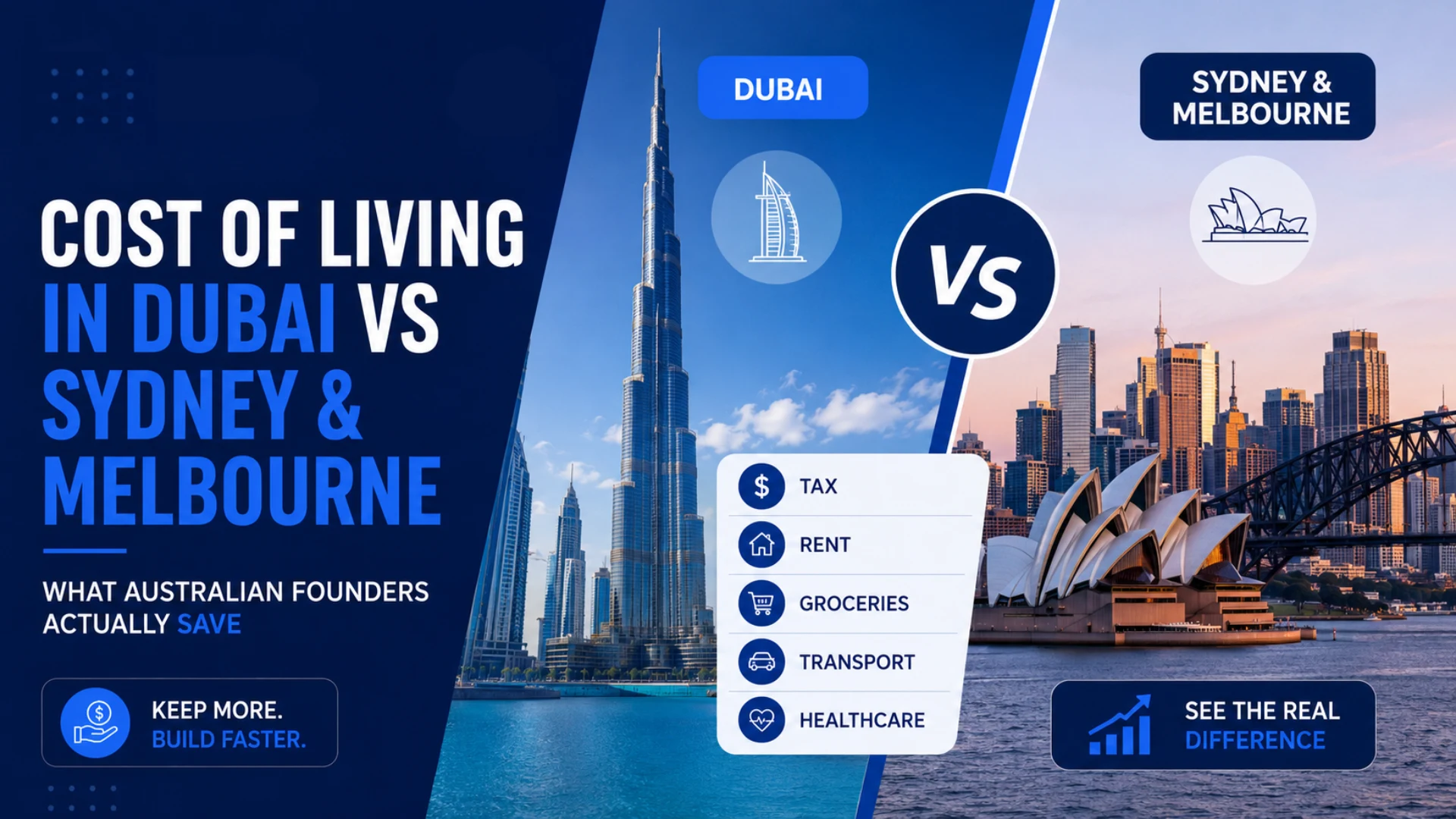
Executive summary: A direct cost-of-living comparison between Dubai and Sydney and Melbourne reveals that while rents in central areas are broadly comparable to Sydney and Melbourne equivalents, groceries, dining, transport, and healthcare are significantly cheaper in Dubai. The decisive difference is the tax position. An Australian founder earning AUD 300,000 per year saves approximately AUD 115,000 in income tax by becoming a UAE tax resident. That saving changes the net financial outcome at every lifestyle level.
Sydney and Melbourne are consistently ranked among the most expensive cities in the world for expatriates. Dubai is often assumed to be in the same category. The reality is more nuanced, and the full picture, particularly once the tax difference is included, changes the comparison dramatically.
This article compares the ongoing monthly cost of living in Dubai with Sydney and Melbourne across every major spending category, using real figures in Australian dollars. It covers rent, groceries, dining, transport, healthcare, and schooling. And it shows what the net financial outcome looks like at three different income levels once Australia’s 47% top tax rate is compared against Dubai’s 0%.
For the one-off costs of the move itself, the moving costs guide covers those separately. This article is about what ongoing life costs once you are settled. For a founder’s perspective on what life in Dubai actually feels like day-to-day, our founder Kevin McKenzie’s real monthly spending breakdown is the most detailed firsthand account available.
Lucas Aoun, the Australian biohacker and founder of Boost Your Biology, who relocated from Australia to Dubai with GenZone, described Dubai as a city built for people who are building things seriously. The financial case is one part of that picture. Here is what it actually looks like.
Also, read our living cost comparison of Toronto vs. Dubai and Bali Vs Dubai here.
The Tax Difference: The Number That Changes Everything
Before comparing grocery prices and restaurant bills, the tax difference needs to be stated clearly, as it is the number that makes all other comparisons meaningful.
An Australian founder earning AUD 200,000 per year pays approximately AUD 67,000 in income tax and Medicare levy. They take home AUD 133,000.
The same founder as a UAE tax resident with a properly structured Dubai free zone company takes home AUD 200,000. The full amount. Every year.
At AUD 300,000 per year the annual saving is approximately AUD 115,000. At AUD 500,000 per year the annual saving is approximately AUD 215,000. At AUD 1,000,000 per year the annual saving exceeds AUD 430,000.
A founder who pays AUD 30,000 more per year in Dubai rent but saves AUD 115,000 in tax is AUD 85,000 per year better off than before the move. That is the framing that makes everything else make sense.
Rent: Broadly Comparable in Central Areas, Cheaper Outside Them
Central Areas Comparison
Central Sydney (CBD, Pyrmont, Surry Hills): AUD 30,000 to AUD 55,000 per year for a one-bedroom apartment Central Melbourne (CBD, Southbank, Fitzroy): AUD 25,000 to AUD 45,000 per year for a one-bedroom apartment Central Dubai (Downtown, Business Bay, Marina): AUD 32,000 to AUD 60,000 per year for a one-bedroom apartment
Affordable Areas Comparison
Affordable Dubai areas (JVC, Al Barsha, JLT): AUD 18,000 to AUD 30,000 per year for a one-bedroom apartment
In central areas, Dubai and Sydney are broadly comparable in rent. Melbourne is slightly cheaper than both. In affordable outer areas, Dubai is significantly cheaper than equivalent suburbs in Sydney or Melbourne. The important practical difference is that rent in Dubai is typically paid annually upfront by post-dated cheque. The full breakdown of how rent works in Dubai is covered in the residency guide.
Groceries: Dubai Is Significantly Cheaper
This surprises most Australian founders because Dubai imports almost everything while Australia produces its own food. But Dubai’s port infrastructure and trade volume keep grocery prices below those in Australia across almost every category.
Full-fat milk per litre: Sydney AUD 2.20, Melbourne AUD 2.10, Dubai AUD 0.85 Bread (500g loaf): Sydney AUD 4.50, Melbourne AUD 4.20, Dubai AUD 1.30 Chicken breast per kg: Sydney AUD 16.00, Melbourne AUD 14.00, Dubai AUD 8.50 Eggs (12): Sydney AUD 7.50, Melbourne AUD 7.00, Dubai AUD 3.80 Rice per kg: Sydney AUD 3.00, Melbourne AUD 2.80, Dubai AUD 1.60
A couple shopping at mid-range supermarkets in Dubai spends approximately AUD 1,200-1,600 per month on groceries. The equivalent spend at Coles or Woolworths in Sydney or Melbourne for the same quality basket runs AUD 1,800 to AUD 2,400 per month.
Dining: Cheaper Across All Categories in Dubai
Casual restaurant meal for one: Sydney AUD 25 to AUD 35, Melbourne AUD 22 to AUD 32, Dubai AUD 12 to AUD 22. Mid-range restaurant meal for two: Sydney AUD 100 to AUD 160, Melbourne AUD 90 to AUD 140, Dubai AUD 70 to AUD 110. Coffee: Sydney AUD 5.50 to AUD 7.00, Melbourne AUD 5.00 to AUD 6.50, Dubai AUD 4.00 to AUD 6.00
Dubai dining across all price points is cheaper than Sydney and Melbourne equivalents. The range and quality of dining in Dubai is exceptional for an internationally mobile founder, with every cuisine represented at every price point.
Transport: Dubai Is Significantly Cheaper
Monthly public transport pass: Sydney AUD 225, Melbourne AUD 200, Dubai AUD 130 Uber or ride-hailing for 8km journey: Sydney AUD 25 to AUD 35, Melbourne AUD 22 to AUD 30, Dubai AUD 10 to AUD 15 Petrol per litre: Sydney AUD 2.00 to AUD 2.30, Melbourne AUD 1.90 to AUD 2.20, Dubai AUD 1.20 to AUD 1.40 Car registration annual: Sydney AUD 600 to AUD 1,000, Melbourne AUD 500 to AUD 900, Dubai AUD 0 (no equivalent registration tax)
Transport in Dubai is substantially cheaper than in Sydney or Melbourne across all categories. The difference is that Dubai’s public transport network, while good on main corridors, is less comprehensive than Sydney’s or Melbourne’s in outer areas. Many founders use a combination of Uber or Careem and the metro rather than owning a car.
Healthcare: Private vs Public
This is the most structurally different category. In Australia, Medicare provides free or subsidised healthcare for Australian residents. In Dubai, all healthcare is private and mandatory health insurance is required for all residents.
Health Insurance Costs in Dubai
For a single adult in good health, basic compliance coverage runs approximately AUD 1,200 to AUD 2,000 per year. Comprehensive coverage runs AUD 3,200 to AUD 6,000 per year. Family coverage for two adults and two children runs AUD 8,000 to AUD 18,000 per year.
For healthy people, the annual health insurance premium is the primary additional cost. The quality of care at Dubai’s major hospitals is excellent, and wait times are significantly shorter than Australia’s public system for elective procedures and specialist consultations.
Schooling: Dubai Is Significantly More Expensive Than Australian Public Schools
This is the clearest category where Dubai is more expensive than Australia for families.
Australia has a free public school system. Dubai has no free public schooling for expatriates. International school fees in Dubai run from AUD 10,000 per year at entry level to AUD 38,000 per year at premium institutions, per child.
For a family with two school-age children at mid-tier Dubai schools, school fees add approximately AUD 40,000 to AUD 70,000 per year to the cost of living compared to free Australian public schooling.
This is the most significant cost consideration for families. For most families where both parents earn a meaningful income, the tax savings still exceed the school fees at Australian income levels above AUD 250,000 per year. But for single-income families with multiple children, school fees need to be modeled carefully.
The Net Financial Outcome: Three Income Scenarios
Here is what the full picture looks like at three income levels for a solo founder, combining the tax saving with the difference in living costs between central Dubai and central Sydney.
Scenario 1: AUD 200,000 Annual Income
Australian income tax saved: AUD 67,000 per year Estimated additional Dubai living costs vs Sydney (premium suburb, no school fees): AUD 5,000 to AUD 15,000 per year Net annual advantage of Dubai: AUD 52,000 to AUD 62,000 per year
Scenario 2: AUD 300,000 Annual Income
Australian income tax saved: AUD 115,000 per year Estimated additional Dubai living costs vs Sydney (premium suburb, no school fees): AUD 5,000 to AUD 15,000 per year Net annual advantage of Dubai: AUD 100,000 to AUD 110,000 per year
Scenario 3: AUD 500,000 Annual Income
Australian income tax saved: AUD 215,000 per year Estimated additional Dubai living costs vs Sydney (premium suburb, no school fees): AUD 5,000 to AUD 15,000 per year Net annual advantage of Dubai: AUD 200,000 to AUD 210,000 per year
For families with school-age children, subtract the annual school fee cost (approximately AUD 40,000 to AUD 70,000 for two children) from the net advantage figures above. Even with school fees, the financial advantage of Dubai is substantial at income levels above AUD 250,000 per year.
What This Means in Practice
The numbers above are why over 200 Australian founders have made this move with GenZone. For the full picture of what the move itself costs, visas, licences, flights, deposits, and everything in between, see the complete breakdown of how much it costs to move to Dubai from Australia.
The UAE company setup service page covers everything GenZone handles, and a free strategy call with the team gets to the specifics of what the right structure looks like for a particular situation in under 30 minutes.
This article provides general estimates for comparison purposes. Individual tax outcomes, cost-of-living choices, and family circumstances vary significantly. Consult a qualified Australian tax professional for advice specific to your situation before making any decisions about tax residency.
