





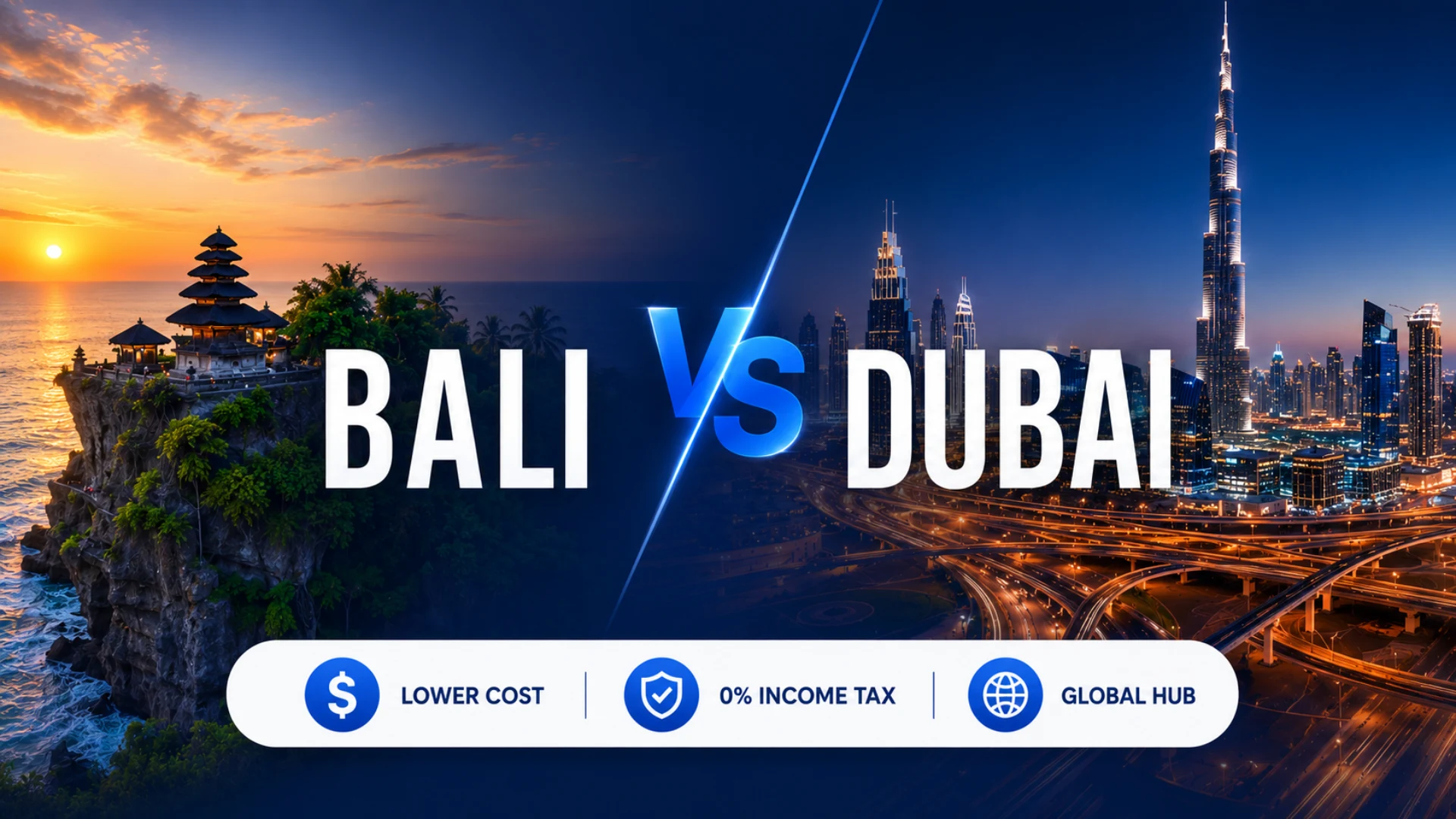
Executive Summary: Bali and Dubai aren’t competing choices, they’re complementary ones. Dubai offers 0% personal income tax, formally recognised tax residency, freehold property ownership, world-class banking, and 10-year visa pathways. Bali offers lifestyle, affordability, and a slower pace. For entrepreneurs at meaningful income levels, Bali’s cheaper cost of living is wiped out by Indonesia’s 35% tax rate. The smart play: build your structure in Dubai, then travel freely, including to Bali.
Every year, thousands of entrepreneurs find themselves asking the same question. Bali looks incredible on Instagram, the cost of living is a fraction of what they pay at home, and the community of digital nomads has never been larger. Dubai, on the other hand, is serious, structured, and increasingly on the radar of every founder who has looked seriously at their tax bill and decided something has to change.
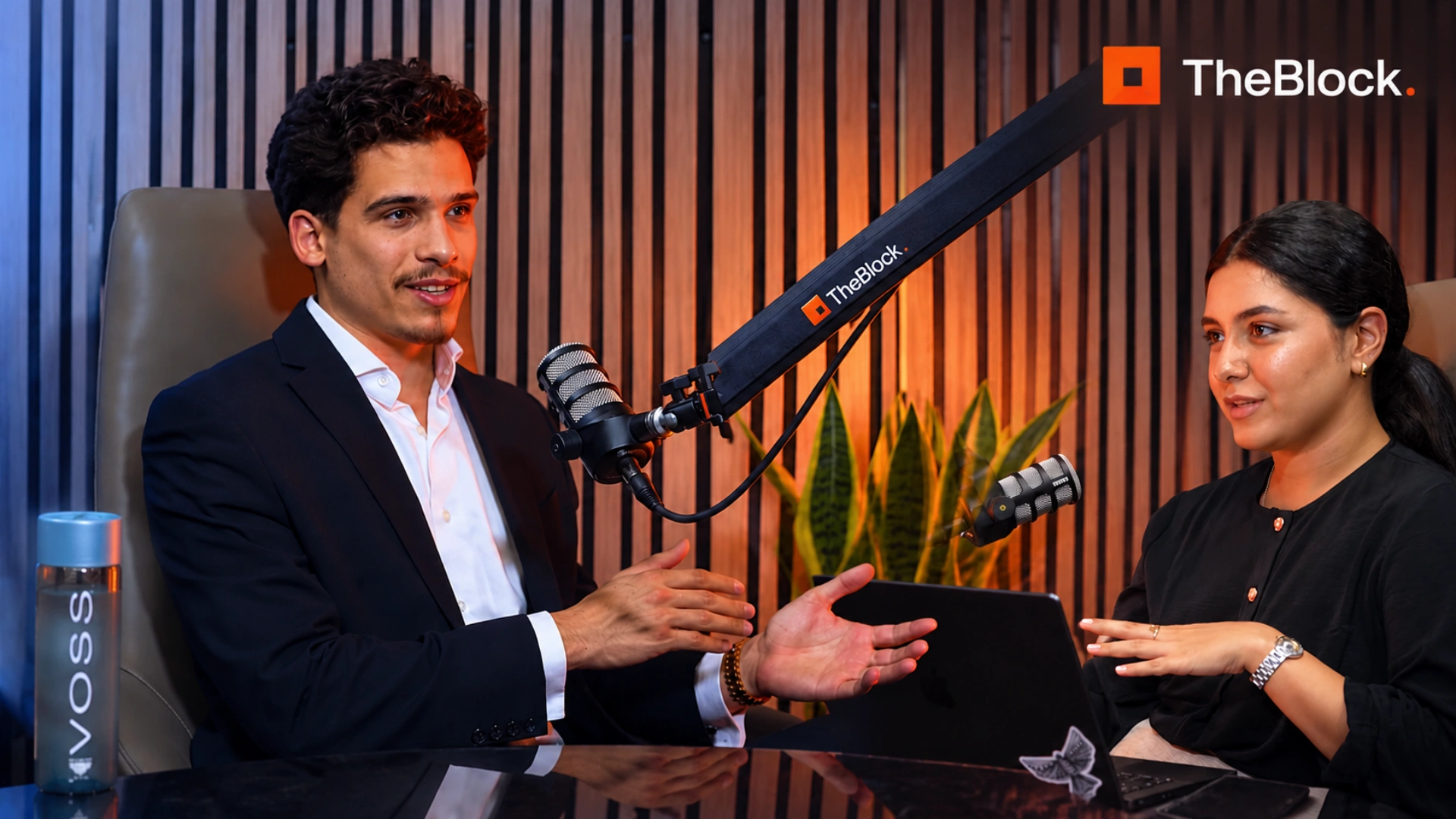
Two entrepreneurs with direct experience in both cities have sat with this question and arrived at the same answer, from slightly different angles and for slightly different reasons. Kevin McKenzie is the co-founder of GenZone, who has lived in Dubai for years, helped over 1,100 founders across 50 countries set up their companies in the UAE, and visits Bali regularly, spending weeks there at a time.
Tuomas Kivioja is a GenZone promoter, who set up his business in Dubai, works closely with us, uses it as his permanent base, and like Kevin, has spent extended time in Bali seeing the alternative for himself.
What follows is not a promotional piece for Dubai. Both Kevin and Tuomas love Bali. Both spend real time there. What follows is the honest answer to a question that hundreds of GenZone clients ask before making one of the most significant financial and lifestyle decisions of their lives.
Bali vs Dubai: Which Is Better for Your Business?
Kevin McKenzie has lived in Dubai for years and spends weeks at a time in Bali. Here is the honest answer.
| Category | 🇮🇩 Bali | 🇦🇪 Dubai | Winner |
|---|---|---|---|
| 💵Taxes | 35% income, 22% corporate. E33G exemption capped at 2 years, not globally recognised. | 0% personal, 0% qualifying Free Zone corporate. Globally recognised TRC. | Dubai |
| 🏥Visa and residency | B211A valid 60 to 180 days. E33G 2-year max. No path to permanent status or formal tax exit. | 2-year company visa or 10-year Golden Visa. Emirates ID. Full international legal status. | Dubai |
| 📱Internet and infrastructure | 50 to 100 Mbps in Canggu. Quality varies villa to villa. Starlink fills gaps at USD 40 to 60/mo. | Among the world’s fastest and most reliable. Consistent across all areas. | Dubai |
| 🏭Banking | Limited multi-currency access. International transfers slower. Crypto framework immature. | USD, EUR, GBP, AED accounts. Clean international rails. Regulated crypto exchanges. | Dubai |
| 🏠Property ownership | Foreigners cannot own freehold. Leasehold only (30 years). Nominee structures required. | Full freehold ownership in designated zones. AED 2M qualifies for 10-year Golden Visa. | Dubai |
| 🛡Safety | Safe by global standards. Petty theft present. Road safety requires care on motorbikes. | Consistently top 5 globally. Virtually no crime. No visible risk at any wealth level. | Dubai |
| 💰Cost of living | USD 1,500 to 4,000/mo. Genuinely cheaper sticker price across all categories. | USD 3,500 to 7,000/mo. Higher gross costs, lower net-of-tax cost at any meaningful income. | Bali (sticker) |
| 🏭Networking | Strong nomad community, wellness-focused. Lower income range on average. | Dense concentration of serious builders, investors, and high-earning founders. | Dubai |
| 🌞Climate | Dry season May to September. Wet season Oct to April. Warm year-round. | Perfect Oct to April. Extreme heat June to September. Complements Bali perfectly. | Complementary |

- You earn meaningful income that taxes are currently consuming
- You need formally recognised tax residency banks and governments accept
- You need reliable banking and global payment infrastructure
- You want freehold property with full legal title
- You can spend at least 90 days per year in the UAE
- Your Dubai tax structure is already established and documented
- You want an affordable, beautiful base during Dubai’s summer months
- You value a wellness community and slower pace for a few months a year
- You stay under 183 days in Indonesia and avoid an Indonesian residence permit
- You treat it as lifestyle enrichment, not your business base
The Honest Starting Point
Before getting into specifics, both Kevin and Tuomas are clear on something that most Bali-versus-Dubai articles miss entirely: this is not a binary choice, and it is not a simple “one is better” conversation.
Kevin puts it directly: “Would I live in Bali? Absolutely, I would live here to an extent, around one to three months per year. After spending two weeks here I could definitely see myself being here for part of the year. But Dubai is my main hub and I will never move out of Dubai.”
Tuomas echoes the same logic. Having established his residency and company in Dubai, he uses it as his permanent base but travels freely, and Bali is one of the places he returns to. The two are not competing choices for him. They are complementary ones.
But if the question is where to incorporate a company, establish tax residency, build long-term financial infrastructure, and operate a serious international business, both agree the comparison is not particularly close.
1. Taxes: The Number That Changes Everything
This is where most Western entrepreneurs feel the difference most sharply, because most of them are coming from countries where 30 to 50% of their income disappears before they can invest it, reinvest it, or simply keep it.
What Indonesia Actually Looks Like
Indonesia runs a progressive personal income tax system with rates climbing to 35% for high earners. Corporate tax sits at 22%. If you are considered an Indonesian tax resident, which happens after 183 days of physical presence in any rolling 12-month period, these rates apply to your worldwide income.
Kevin flags a critical and widely misunderstood detail: “Even if you don’t spend more than six months in the country, but you hold a residence permit there, that actually makes you a tax resident. So you want to consider this when you are choosing the type of visa you’re going to get.”
Indonesia’s E33G remote worker visa, launched formally in 2026, does offer a four-year exemption from Indonesian tax on foreign-sourced income. But it requires proof of at least USD 60,000 annual income, caps at two years with one renewal, and critically, Indonesia has no Tax Residency Certificate that is formally recognised internationally. Banks and foreign tax authorities will not accept an E33G visa as proof of tax residency the way a UAE Tax Residency Certificate is accepted globally.
For a Western entrepreneur leaving a high-tax home country, this matters enormously. The goal is not just a low-tax place to live. The goal is a formally recognised legal status that a home country tax authority, a bank, and business partners will accept as evidence of changed tax residency.
What Dubai Actually Looks Like
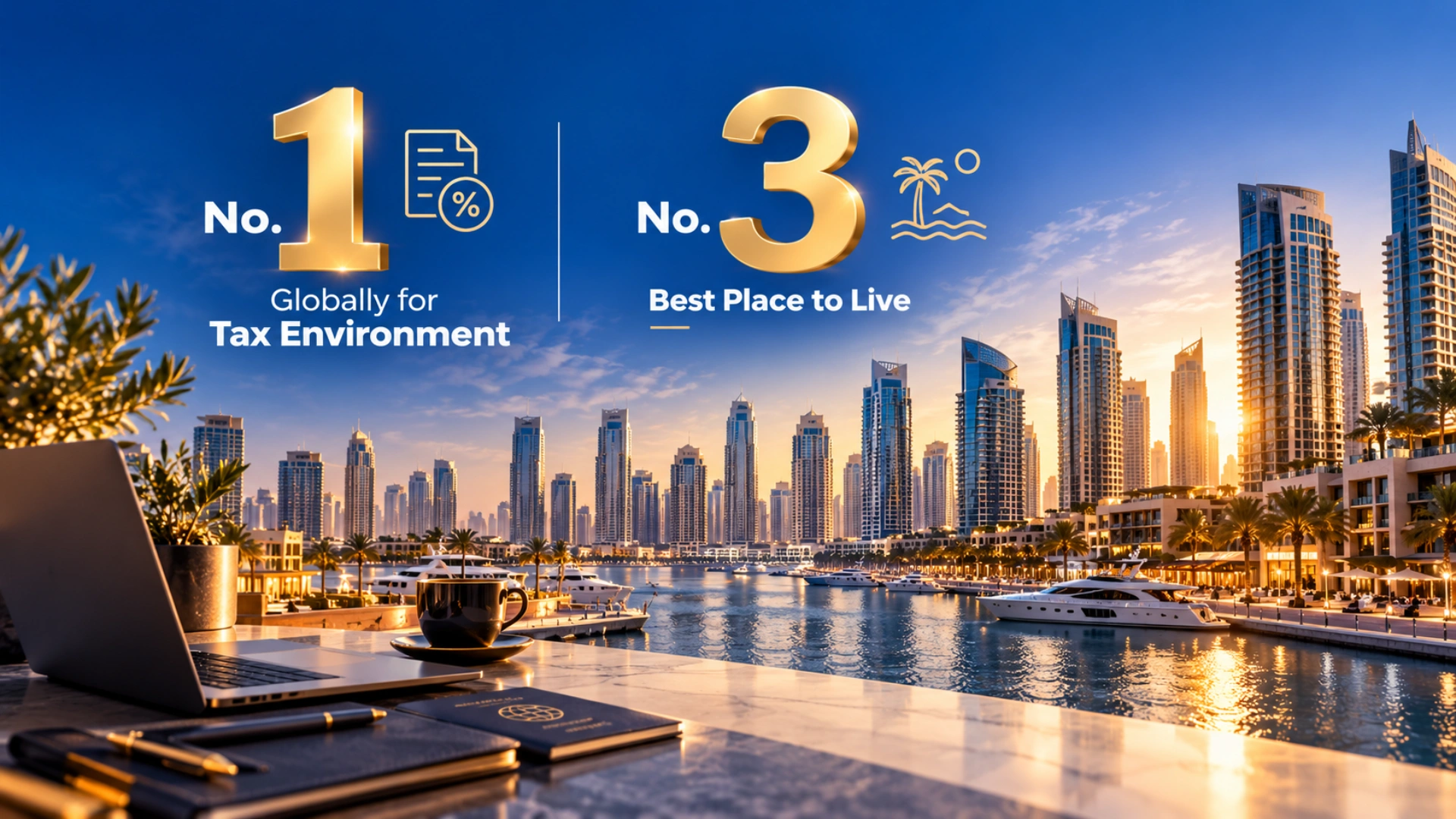
The UAE has 0% personal income tax with no exceptions, no salary thresholds, and no income types excluded. Dividends, capital gains, crypto profits, consulting fees, employment income, all of it is received tax-free by UAE tax residents.
UAE corporate tax, introduced in 2023, applies at 9% on net profits above AED 375,000 (approximately USD 102,000) per year. Below that threshold, nothing. Qualifying free zone businesses remain fully exempt, provided they meet the conditions around activities and economic substance.
To qualify as a UAE tax resident, a founder needs a UAE residency visa and a minimum of 90 days of physical presence in the UAE per 12-month period. The Federal Tax Authority then issues a Tax Residency Certificate recognised by governments and banks worldwide. GenZone has a 100% TRC approval rate across all clients.
Kevin’s arithmetic is stark: “The highest tax rate in Indonesia is over 30% while in Dubai we have 0% income tax. On a corporate level, Dubai has 0 or 9% corporate tax depending on how much money you make, while in Bali it’s around 22%.”
For a founder earning USD 200,000 per year, the annual tax saving from establishing UAE residency rather than Indonesian tax residency runs USD 50,000 to USD 70,000. Over five years that is USD 250,000 to USD 350,000 that stays with the founder rather than going to government. Tuomas frames it simply: once you factor in taxes, Bali’s cheaper cost of living stops being an advantage at any meaningful income level.
2. Visas and Residency: Stability vs Complexity
Bali in 2026
Bali’s visa situation has improved in recent years but remains significantly more complex and less stable than Dubai’s.
The most commonly used route for digital nomads is the B211A social/cultural visa, covering 60 days, extendable to 180, costing around USD 300 including extensions. It does not officially permit working, but it is what most remote workers use in practice. Indonesia has been tightening enforcement on this throughout 2025 and 2026.
The E33G Remote Worker KITAS is Indonesia’s formal remote work visa. It legally permits working remotely for foreign companies, costs around USD 600, and is valid for one year with one renewal. But it does not provide a path to permanent residency, does not resolve formal tax residency, and caps out at two years maximum.
The Second Home Visa offers up to 10 years of residency but requires proof of USD 130,000 in savings or a qualifying property investment, and still does not provide the formal tax residency infrastructure that Dubai offers.
In practice, most people in Bali are cycling through B211A visas and managing extensions. It is a workable lifestyle setup. It is not a long-term business infrastructure.
Dubai in 2026
UAE residency through a free zone or mainland company is a formal, internationally recognised legal status. From arrival in Dubai to Emirates ID in hand takes 7 to 14 days. The Emirates ID functions as a primary identity document for banking, contracts, healthcare, and government services.
The standard residency visa runs two years and is straightforwardly renewable. The 10-year Golden Visa is available through a property purchase of AED 2,000,000 or more, giving a decade of secure residency with no annual company renewal required. UAE residency can sponsor family members and provides the foundation for the Tax Residency Certificate that formally ends home-country tax obligations.
Tuomas’s experience: the setup process through GenZone was faster and simpler than he expected. Company registered, visa processed, Emirates ID issued, bank account opened, the entire sequence completed in under two weeks. The full step-by-step process is covered in the Dubai residency guide.
3. Infrastructure: The Day-to-Day Reality
Tuomas runs his business online. So does Kevin. So do the vast majority of Western entrepreneurs genuinely considering this choice. For them, infrastructure is not an abstract consideration. It is the practical environment in which they work every single day.
Kevin is direct from his time in Bali: “Small things like the Wi-Fi not being as good as it is in Dubai can actually impact someone’s life pretty dramatically. You need to make sure your internet is good and it’s just way better in Dubai. I think Dubai actually has one of the fastest internet speeds in the entire world.”
He also notes the inconsistency that anyone spending real time in Bali will encounter: “In this particular villa where I’m staying, the internet is pretty good. But in the previous villa I stayed the internet was simply awful, which makes doing work quite difficult sometimes.” Starlink is increasingly used as a workaround at USD 40 to USD 60 per month, but it adds a layer of management that Dubai does not require.
Beyond internet, Dubai’s infrastructure advantage is comprehensive. Power is completely stable. Roads are world-class. The metro covers main city corridors. Dubai International Airport connects directly to almost every major city globally. Government processes are largely digitised and genuinely fast by international standards.
Bali has improved significantly. Fibre connections delivering 50 to 100 Mbps are now standard in Canggu and Seminyak. But reliability still varies building by building, and for a founder whose business depends on consistent connectivity and fast payment processing, the practical difference matters.
4. Banking: Frictionless vs Friction
Kevin is direct on this too: “Banking is a little bit more limited in Bali and it’s just not as good as it is in Dubai. We have different currency pairs that you can have in the UAE. You can have USD accounts, EUR accounts, GBP accounts, AED accounts. There’s just a lot less restriction on international banking in Dubai.”
For Western entrepreneurs, this matters across several dimensions. Opening a legitimate business bank account as a foreigner in Indonesia is genuinely difficult. International transfers are slower and more expensive. Stripe and PayPal operate in Indonesia but payouts into Indonesian bank accounts involve significantly more friction than most founders want.
On crypto specifically, Kevin draws an important distinction: “We have amazing exchanges for crypto in the UAE and these exchanges are actually regulated. You can fully do this compliantly and cash out crypto without having any issues in Dubai.” Indonesia’s regulatory framework for digital assets remains comparatively immature by comparison. The full guide on cashing out crypto in Dubai covers this in detail.
A development Kevin specifically highlights: the UAE was removed from the EU’s financial grey list for high-risk money laundering jurisdictions, making UAE banking more accessible for international clients, particularly those with European counterparties.
Tuomas found Dubai banking straightforwardly accessible after establishing residency. Multiple currency accounts, clean international rails, no friction with European and North American clients. For a detailed breakdown of the best banking options, the top 3 online banks in Dubai and the Wio Bank guide cover everything a new resident needs to know. The guide on why Dubai banks reject business accounts is worth reading before applying.
5. Property: Ownership vs Leasehold
This is where the long-term financial planning difference becomes clearest, and where Kevin’s direct experience in both markets makes the contrast concrete.
Kevin on Bali: “If you actually look into the logistics of buying a property in Bali, it doesn’t make sense at all. You have to do this through nominee structures or having a company structure. In Bali it’s what’s called leasehold properties. You’re just leasing the right to own this property for a certain number of years. After that 30 years is up, who knows if they’re actually going to want to renew it and let you keep it.”
Foreigners in Indonesia cannot own freehold residential property directly. Ownership requires Indonesian corporate entities, nominee arrangements with local partners, or long-term leases, all of which carry legal risk and require ongoing management. They do not provide the same security as direct legal title.
In Dubai, foreigners can purchase property in designated freehold zones with full ownership rights, no nominee, no corporate wrapper, no leasehold cliff. The Dubai Land Department maintains a transparent register. The market is liquid. Rental yields run 5 to 8% gross, among the highest in the world for a major global city. And a purchase of AED 2,000,000 or more qualifies for the 10-year Golden Visa. Tech With Tim (Tim Ruscica) bought property in Downtown Dubai and secured his Golden Visa through GenZone, combining a long-term asset with a decade of residency security.
For a Western entrepreneur thinking about where to park long-term capital, the difference in legal security between Dubai freehold and Bali leasehold is not a minor detail. The Dubai real estate service covers how to approach property purchase as a foreign buyer.
6. Safety: Both Good, One Exceptional
Both Kevin and Tuomas give Bali genuine credit here. It is a safe destination by global standards. The people are welcoming, and for a sensible traveller exercising normal precautions, it presents low risk.
Kevin draws an honest distinction from personal experience: “I will say Bali is safe. It’s safe because you’re making it safe as well. You’re not traveling here with a ton of money. There is a lot more petty theft and there are cases of cleaners stealing or similar things.” He also flags the road safety issue directly: “I actually got hit in my first two weeks here. Someone hit me from the back. The roads are a lot more tight, it’s really built for motorbikes, and there are a lot of tourists who probably shouldn’t be driving who are driving.”
Dubai is a different category entirely: “Dubai is the safest city in the world in my opinion. There’s literally no place I can feel safer. If you do have your Rolex on, $100,000 in cash in your pockets, it does not matter. Literally nobody’s going to rob you.”
Dubai consistently ranks at or near the top of global city safety indices. The legal consequences for criminal behaviour in the UAE are severe and the deterrent effect is real and felt in everyday life. Dubai’s stability during periods of regional uncertainty is addressed separately for anyone concerned about the Middle East context.
7. Cost of Living: Where Bali Actually Wins
This is where the honest answer goes against the Dubai case, and both Kevin and Tuomas acknowledge it directly rather than papering over it.
Bali is significantly cheaper for day-to-day living. A comfortable lifestyle including a well-located villa, food, transport, and coworking space runs USD 1,500 to USD 3,000 per month. A genuinely comfortable lifestyle with regular dining out and good accommodation runs USD 2,500 to USD 4,000.
Dubai costs more. A comfortable solo-founder lifestyle runs USD 3,500 to USD 5,000 per month. Kevin’s own monthly spend in Downtown Dubai runs approximately USD 6,800 for a couple at a premium lifestyle level. The full breakdown of what living in Dubai actually costs is covered in the dedicated guide.
But the cost comparison without the tax context is meaningless. A founder spending USD 2,000 per month in Bali and paying 35% tax on USD 200,000 annual income keeps approximately USD 131,000 per year after tax and living costs. The same founder spending USD 5,000 per month in Dubai and paying 0% tax keeps approximately USD 140,000. Dubai is financially ahead despite the higher sticker price, purely on tax arithmetic. At higher incomes the gap widens dramatically.
8. Lifestyle: Two Completely Different Experiences
This is where the comparison becomes genuinely subjective, and both Kevin and Tuomas are honest that Bali has real appeal that Dubai cannot replicate.
Kevin: “Bali is an amazing place. For a lot of our clients, this is a place where they love to stay because they travel around the world and they end up often being in Bali for two or three months per year.”
Tuomas describes Bali as a place for reset and balance, a contrast to Dubai’s constant forward motion. The gyms are exceptional. The food is healthy. The pace slows down in a way that can be genuinely restorative.
The communities are also genuinely different. Kevin: “The people who generally gravitate to Bali are going to be on a slightly lower income. They’re going to be slightly less serious about building a big business, which by the way is absolutely fair enough. But if you are very serious about business, you’re probably going to find more people similar to you in Dubai because it tends to attract more serious entrepreneurs, people who are building bigger things.” He notes that two of his main income sources would not exist without relationships he formed in Dubai.
Dubai’s lifestyle is a city of ambition and energy rather than relaxation. World-class restaurants, elite gyms, major events, concentrated networking with internationally successful people. For some founders that energy is exactly what they need. For others, Bali offers the balance that Dubai does not.
9. Climate: The Hidden Reason the Two Work So Well Together
One practical point that both Kevin and Tuomas raise: the climates of Bali and Dubai are almost perfectly complementary.
Dubai is exceptional from October through April. The summer months are extreme heat that most people find difficult to enjoy outdoors. Bali’s dry season runs from May through September, exactly the months when Dubai is at its most oppressive. The two climates are almost designed to be used in combination.
Kevin: “You can leave the summers in Dubai, the winters in Bali. And that works quite well, at least for me personally.”
For founders doing 90 to 150 days in Dubai to maintain UAE tax residency, the remaining months can include significant time in Bali without any tax residency conflict, provided they stay under 183 days in Indonesia and do not hold an Indonesian residence permit.
The Decision Framework
Based on Kevin’s experience with 1,100 founders and Tuomas’s direct experience as one of them, here is the honest framework.
Choose Dubai as your primary base if you are earning meaningful income that taxes are currently consuming, you want formally recognised international tax residency that banks and foreign governments accept, you need reliable banking and global payment access, you want to own property with full legal title, and you are committed to spending at least 90 days per year in the UAE.
Add Bali for part of the year if you want an affordable and beautiful base during travel periods, you value a strong wellness community and slower pace, and your primary tax structure is already handled from Dubai.
The answer for most serious Western founders is not Bali or Dubai. It is Dubai as the permanent structure, with Bali as one of several places to enjoy once that structure is in place.
What GenZone Handles For You

GenZone manages the Dubai side end-to-end: company registration, visa processing, Emirates ID, banking introductions, Tax Residency Certificate application, and ongoing tax and accounting compliance. The average timeline from first call to Emirates ID in hand is 10 to 14 days.
For founders who also need US banking, Stripe access, or PayPal alongside their Dubai structure, GenZone also sets up US LLCs for non-resident founders across 50 countries. Many clients combine UAE residency for tax purposes with a US LLC for US payment infrastructure. It is a common and well-established combination that GenZone handles regularly.
If any of this sounds relevant to your situation, book a free strategy call. Kevin and the team will tell you directly whether Dubai makes sense for you, and they will say so if it does not.
Frequently Asked Questions
Can I live in Bali and use Dubai for tax purposes? You can, but it requires discipline. UAE tax residency requires a minimum of 90 days of physical presence in the UAE per year and a valid residency visa. You can spend the remaining time in Bali or anywhere else, but the 90-day requirement needs to be met and documented. The key watch-out on the Bali side: stay under 183 days and do not hold an Indonesian residence permit, or you risk triggering Indonesian tax residency. The full day-count rules and how to manage them are covered in the dedicated guide.
Do I have to choose between Bali and Dubai? No. The most common arrangement among GenZone clients is Dubai as the primary base for 90 to 150 days per year, then travelling freely, including extended stays in Bali, Europe, Southeast Asia, or wherever they prefer. Dubai provides the structure. Everything else is lifestyle.
Is Bali’s E33G visa a real alternative to UAE residency? Not for someone who wants formally recognised international tax residency. The E33G permits legal remote work in Bali but does not resolve home-country tax obligations, is not widely accepted as proof of tax residency by foreign banks and tax authorities, and caps out at two years maximum. UAE residency with a Tax Residency Certificate is a structurally different and far more robust solution.
How much does it cost to set up in Dubai? Company setup costs run approximately AED 16,000 to AED 25,000 (USD 4,400 to USD 6,800) for the first year including company registration, visa, and Emirates ID. Annual maintenance runs AED 10,000 to AED 20,000. For most founders earning above USD 100,000 per year, the first year’s tax saving alone covers the setup cost multiple times over.
Is Dubai really safe to live in? Yes. Dubai consistently ranks among the top five safest cities globally by crime rate. Kevin addresses this directly from personal experience in Bali and Dubai. For anyone concerned about regional stability, Dubai’s track record during periods of regional uncertainty is covered in a dedicated post.
GenZone is a Dubai-based company run by founders who made the move themselves and have since helped 1,100 others do the same. Visit the Dubai company setup service, explore the Dubai residency guide, or book a free strategy call to talk through your specific situation.
