




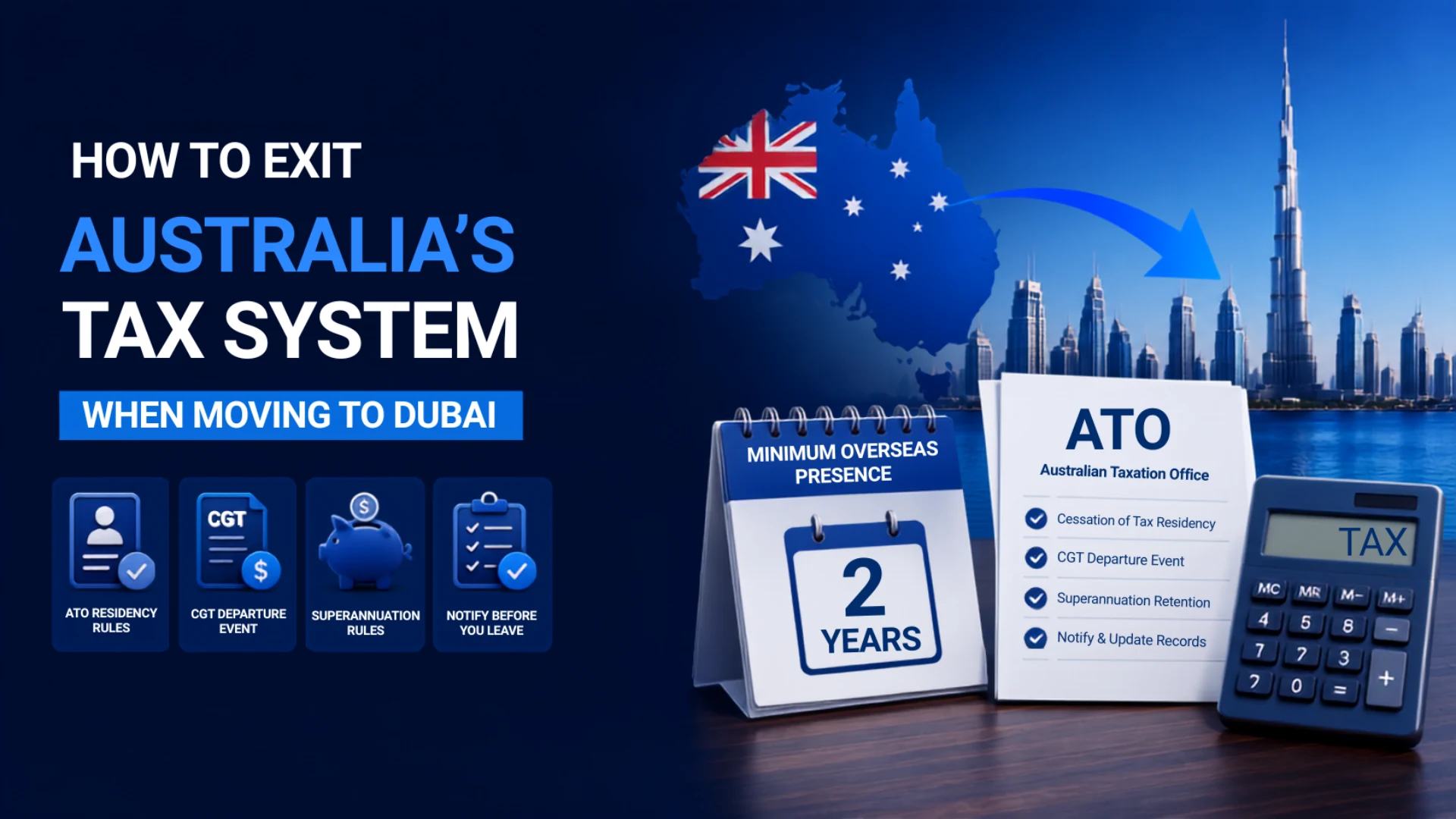
Executive summary: Ceasing Australian tax residency requires satisfying the ATO’s domicile test by establishing a permanent place of abode overseas for at least 2 years, rather than merely spending fewer than 183 days in Australia. On departure, a CGT deemed disposal event applies to most non-Australian assets, including shares, crypto, and business interests. Superannuation remains preserved in Australia regardless of residency. Australia has no tax treaty with the UAE, making a clean and properly structured exit more critical than for founders moving to treaty countries.
Australia has one of the most aggressive tax systems in the world when it comes to retaining its residents. The Australian Taxation Office (ATO) does not simply accept that a founder has left the country because he/she bought a plane ticket and registered a company abroad.
Properly breaking Australian tax residencyis a process that requires advance planning, the right structure in both jurisdictions, and a minimum of two years of genuine overseas presence.
This guide covers exactly what that process involves for Australian founders relocating to Dubai. It is the technical companion to the complete guide to moving to Dubai from Australia, which covers the broader relocation picture. This article focuses specifically on the Australian tax side.
Lucas Aoun, the Australian biohacker and founder of Boost Your Biology, relocated from Australia to Dubai with GenZone and described the process as headache-free and free of guesswork. That outcome is only possible when the Australian exit and the UAE setup are coordinated correctly from the start.
The Starting Point: Why You Are a Tax Resident of Australia
If you are an Australian citizen or permanent resident living in Australia, the ATO considers you an Australian tax resident. As an Australian tax resident, you pay income tax on your worldwide income, not just Australian income, all income, anywhere in the world.
That means if you have a company in Dubai, a US LLC, or a client in London paying into a European bank account, the ATO expects to tax all of it at Australian marginal rates.
The current rates for 2025-26 are as follows, not including the 2% Medicare levy:
0% on income up to AUD 18,200 16% on AUD 18,201 to AUD 45,000 30% on AUD 45,001 to AUD 135,000 37% on AUD 135,001 to AUD 190,000 45% on AUD 190,001 and above
Adding the 2% Medicare levy brings the effective top rate to 47%. Note: from 1 July 2026 (the 2026-27 financial year), the 16% bracket reduces to 15%, saving a maximum of AUD 268 per year for earners above AUD 45,000. The 37% and 45% brackets remain unchanged.
Becoming a non-resident of Australia for tax purposes changes this entirely. As a non-resident, you only pay Australian tax on Australian-sourced income, which typically means Australian bank interest, rental income from Australian property, and dividends from Australian shares.
That said, foreign income, including income from your UAE company, is no longer subject to Australian tax. That is the goal. Here is what it takes to get there.
The Three ATO Residency Tests
Australia uses three tests to determine tax residency. For Australian citizens and permanent residents looking to move to Dubai, the most important of the three is the domicile test.
The 183-Day Test
If you spend more than 183 days in Australia in a given tax year, whether consecutive or non-consecutive, you are automatically considered an Australian tax resident for that year.
Most founders planning a genuine Dubai relocation will naturally fall below this threshold, but passing the 183-day test alone does not make you a non-resident. It is a threshold, not an exit mechanism for residency.
The Resides Test
The ATO looks at a range of factors to assess whether a person is residing in Australia. These include your intention and purpose when in Australia, the maintenance and location of your assets, your family and business ties, and your social and living arrangements. This test is most commonly applied to people coming into Australia rather than leaving, but it can be relevant if a founder maintains strong ongoing ties.
The Domicile Test
This is the critical test for Australian citizens and permanent residents planning to move to Dubai. Under the domicile test, a person is considered a non-resident if their permanent place of abode is established outside Australia to the ATO’s satisfaction.
Establishing a permanent place of abode in Dubai requires demonstrating all of the following: a long-term UAE residency visa (the 2-year free zone company visa or the 10-year Golden Visa both satisfy this), long-term accommodation in Dubai (a signed tenancy agreement or owned property), a business genuinely managed and operated from Dubai, and ideally a minimum of two years of continuous committed UAE presence.
The ATO’s position is explicit: a short-term departure does not break Australian tax residency. The UAE is particularly well-suited to satisfying this test because it offers formal long-term visas with a clear renewal structure, unlike digital nomad visas in other countries which cap out at six months to one year.
Two Years: The Minimum Threshold
The two-year minimum is the single most important practical point in this entire guide. If you are planning a Dubai setup and are only considering 12 months, you are almost certainly not exiting the Australian tax system.
The ATO requires a genuine and permanent change of residence. One year overseas, even with a UAE residency visa and a Dubai company, is typically not enough to satisfy the domicile test to the ATO’s standard.
Two years is the minimum that most Australian tax professionals consider reliable, and even then the quality of the ties established in Dubai and the ties severed in Australia matter.
Founders who cut Australian ties properly are in a much stronger position than those who maintain an Australian base they could return to at any time. Cutting ties means renting out or selling Australian property, cancelling Australian leases, notifying Medicare and the Electoral Commission, transferring possessions to Dubai, and establishing genuine UAE banking and business operations.
The CGT Departure Event: Australia’s Exit Tax
This is the section that catches most founders off guard, and it is the most important planning point for anyone with valuable business interests, shares, or crypto holdings.
When you cease to be an Australian tax resident, the ATO treats most of your non-Australian assets as having been sold at market value on the day of your departure. This is called a deemed disposal or CGT departure event. You are not actually selling anything, but the ATO calculates the capital gain as if you had, and that gain is included in your final Australian tax return.
What the CGT Departure Event Applies To
The CGT departure event applies to: shares listed on the ASX or other exchanges, US shares or international equities, cryptocurrency and digital assets, shares in your own private company or business, and most other capital assets that are not Australian real property.
It does not apply to Australian real property, which remains inside the Australian CGT system regardless of your residency.
How the CGT Rate Works on Departure
The CGT rate on departure is effectively 23.5% on the gain for assets held more than 12 months (the 50% CGT discount reduces the gain by half before the 47% top rate applies). For assets held less than 12 months the full marginal rate applies to the full gain.
Defer or Pay Now?
There is an option to defer the exit CGT rather than pay it at departure. Deferring means any future growth on those assets remains taxable in Australia when you eventually sell. It also means you lose the 50% CGT discount on gains made during the period you are overseas.
For most founders with manageable departure gains, paying the exit CGT upfront and being clean of the Australian system is the better long-term outcome. This calculation requires individual advice from an Australian tax professional.
The Business Valuation Challenge
The valuation of private business interests for CGT departure purposes is the most complex scenario. If a founder has built a business that now turns over millions of dollars, determining its market value on the day of departure requires a formal valuation.
If there is no intention to sell the business and the founder plans to return to Australia eventually, deferral might make more sense. If the founder intends to sell from Dubai, paying the departure CGT and being clean of Australia on any future gain is almost always preferable.
Australian Property: A Critical Decision Before You Leave
The change to Australian property CGT for non-residents is one of the most important decisions to make before departure.
As an Australian tax resident, your main residence is exempt from CGT when you sell it. You can live in a home for 20 years, sell it for a million dollar gain, and pay zero CGT.
As a non-resident, that main residence exemption disappears. If you sell your Australian main residence while you are a non-resident for tax purposes, you pay full CGT on the entire gain, as if it were an investment property. This law changed several years ago and many founders are unaware of it.
The Three Options for Australian Property
Sell before you leave Australia as a tax resident, and the main residence exemption applies as normal.
Rent the property out, maintain your Australian property asset, and sell when you return to Australia as a tax resident, at which point the main residence exemption applies again with some conditions around the rental period.
Remain a non-resident and sell from Dubai, in which case full CGT applies to the entire gain. For properties with large unrealised gains, this option is almost always the most expensive.
Most Australian founders planning a genuine long-term move to Dubai sell their main residence before departure or commit to a rental strategy with a clear plan to sell on return.
Superannuation When You Move to Dubai
Superannuation cannot be accessed early simply because you are moving abroad. It remains preserved in your Australian fund until you reach your preservation age (generally 60), regardless of your country of residence.
As a non-resident, if you eventually access your super, Australian withholding tax applies. The rate depends on your residency status at the time of withdrawal. Australia has no double tax treaty with the UAE, unlike some other countries, such as the US and UK, where treaty provisions can reduce withholding obligations. This means there is no treaty mechanism to reduce Australian withholding tax on super withdrawals for UAE residents.
Most Australian founders moving to Dubai treat superannuation as a long-term Australian retirement asset and leave it entirely untouched while building their primary wealth through their UAE free zone company structure.
What to Notify Before You Leave
Formally notifying Australian institutions is part of establishing the paper trail the ATO may want to see if it ever questions your non-residency status.
The key notifications to make before or immediately after departure: notify Medicare of your departure and cancel or suspend your Medicare card, update your electoral roll address or apply for overseas enrolment, notify your Australian bank accounts of your new overseas address and tax residency status, notify the ATO of your change in residency status in your final Australian tax return, cancel any Australian residential leases, and if you are retaining an Australian Pty Ltd, ensure the structure is reviewed by an Australian tax professional for ongoing compliance.
The No Tax Treaty Position Between Australia and the UAE
Australia has double tax treaties with over 40 countries, including the US, the UK, Germany, France, and Singapore. These treaties provide tie-breaking rules when both countries could claim tax residency, and they often reduce withholding rates on cross-border income.
Australia has no tax treaty with the UAE.
This has two practical implications. First, there are no treaty tie-breaking rules to fall back on if both countries claim taxing rights simultaneously. Second, there is no reduced withholding rate on Australian-sourced income such as dividends or interest for UAE residents. Standard non-resident withholding rates apply.
This makes a clean and properly documented Australian tax exit more important for UAE-bound founders than it is for founders moving to treaty countries.
The Correct Sequence
The practical sequence for a successful Australian tax exit and UAE setup is as follows.
First, engage an Australian tax professional to assess your specific departure tax exposure, value your business interests if applicable, plan the timing of any property sale, and advise on the optimal departure date.
Second, begin your UAE company registration with GenZone. You can easily do it yourself through our intuitive, all-in-one platform – GenZone LaunchPad, a seamless, fully digital experience designed to make setup effortless. The entire process happens remotely while you’re still in Australia, and your trade license is issued in just 3 to 5 business days.
Third, travel to Dubai to complete the visa process (medical, biometrics, Emirates ID) and open your bank accounts. This visit typically takes 7 to 10 days.
Fourth, formally notify Australian institutions of your departure, cancel leases, and complete the paper trail steps described above.
Fifth, file your final Australian tax return for the partial year of Australian residency, including the CGT departure event calculations where applicable.
Sixth, once you have spent 90 days in the UAE within a 12-month period, apply for your UAE Tax Residency Certificate through the Federal Tax Authority. How the day count works and what the TRC process involves is covered in the dedicated guide.
Seventh, maintain genuine substance in Dubai for a minimum of two years to satisfy the ATO’s domicile test.
GenZone handles steps two, three, and six. The Australian tax professional handles steps one and five. GenZone coordinates timing between both sides so nothing falls through the gap.
Common Mistakes Australian Founders Make
Planning a Departure That Is Too Short
Two years is the minimum. Six months in Dubai followed by return to Australia is not a tax exit. It is a temporary overseas trip that the ATO will view as exactly that.
Leaving an Australian Business Running Without Restructuring
An Australian Pty Ltd with an owner now in Dubai, still managing operations, signing contracts, and making decisions from overseas, may result in the ATO viewing management and control of the business as remaining in Australia. This is a specific anti-avoidance risk.
Not Planning the Property Sale Timing
Selling an Australian main residence after becoming a non-resident and paying full CGT on the entire gain when the gain could have been tax-free is an avoidable and expensive mistake.
Splitting Time Between Multiple Countries
Portugal for three months, Bali for two months, Dubai for four months, Australia for three months does not establish a permanent place of abode in Dubai. The ATO requires one country, not a nomadic lifestyle.
Assuming the UAE TRC Alone Resolves the Australian Position
The UAE Tax Residency Certificate is a powerful document and relevant to the ATO’s analysis, but it does not automatically override the ATO’s own residency tests. The full Australian tie-cutting process still needs to happen.
How GenZone Coordinates the Process
GenZone manages the UAE side of every Australian client’s relocation: company registration, visa processing, Emirates ID, banking introductions, Tax Residency Certificate application, and ongoing compliance.
GenZone does not provide Australian tax advice. That requires a licensed Australian tax professional who specializes in international relocation. GenZone can refer Australian clients to the right advisers and ensure that the timing of the Australian exit planning and the UAE setup is in the right sequence, so there are no gaps between the two.
Book a free strategy call to begin the conversation about what your specific Australian exit and Dubai setup would look like.
