








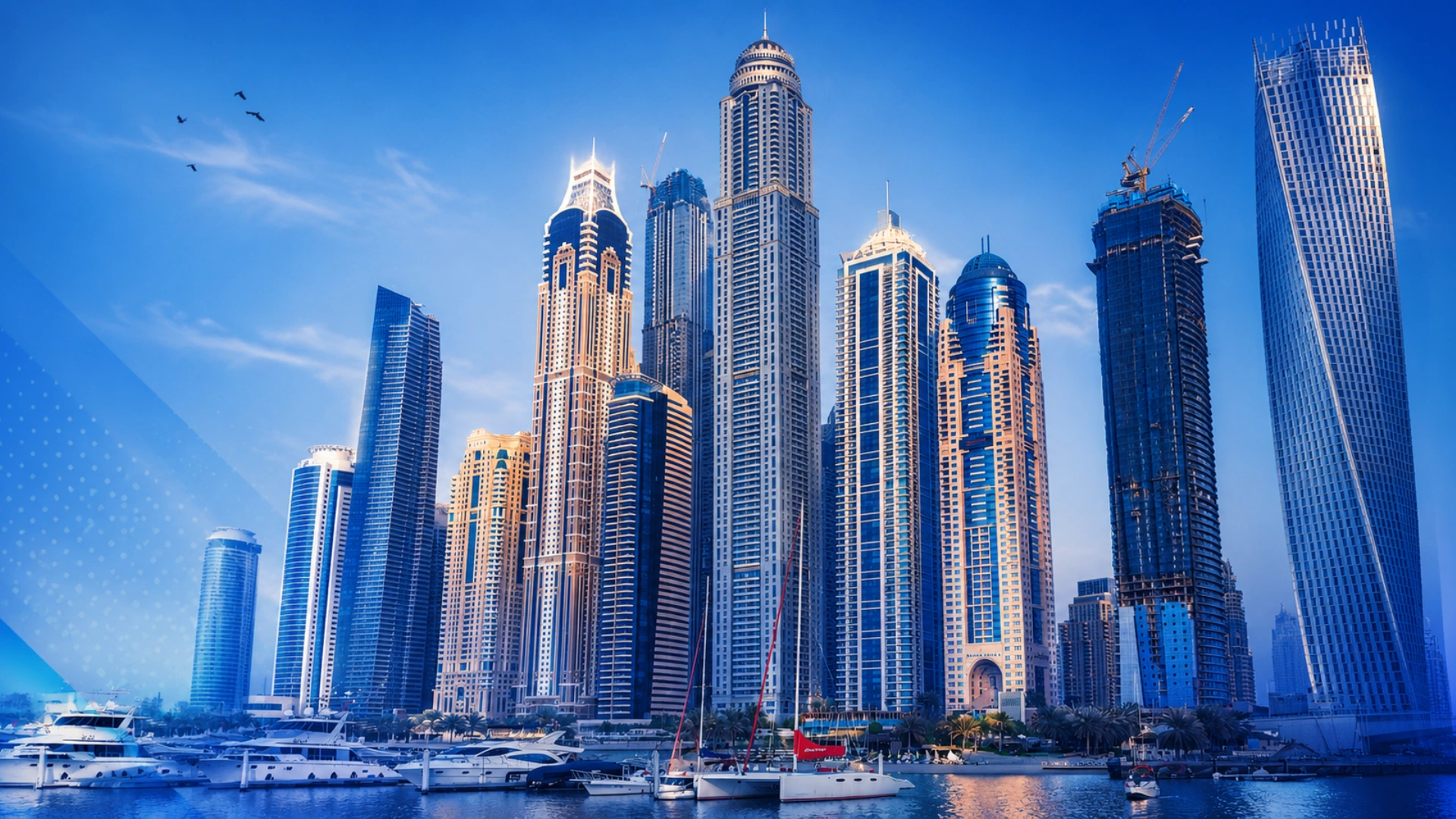
Short answer: No, the Dubai housing market is not crashing. After a record-breaking run in 2024-2025, prices cooled in the first half of 2026 in a genuine correction, triggered by heavy new supply and a regional geopolitical shock in the spring.
But the numbers that matter tell a clear story: transaction volumes fell far more than prices, the decline lost momentum through Q2, and the market steadied again over the summer. What Dubai is going through is a maturation, not a collapse, and for disciplined investors that distinction changes everything.
If you have followed Dubai real estate on social media, in forums, or across the financial press over the last 18 months, one question keeps resurfacing: is the Dubai property market about to crash? The worry has two roots: a wave of new supply (close to 300,000 units due by 2028) and the sharp, unsettling slowdown that hit in early 2026.
At GenZone, we have worked with investors, developers and end-users in Dubai for over five years, through the boom of 2024-2025 and the turbulence of 2026. This is our data-led read on where the market actually stands as of August 2026: supply, demand, prices, rents, the 2026-2030 forecast, and the one segment we would still approach with caution.
Latest Update: Dubai Housing Market, August 2026
Here is the current state of play, in brief, before the detail:
- The correction was real but contained. Dubai’s Residential Price Index fell around 4% in Q2 2026, taking the cumulative decline since late February to roughly 10%, but the pace of decline eased sharply through the quarter, pointing to stabilisation rather than freefall (ValuStrat, via Khaleej Times).
- Prices held up far better than deal volumes. H1 residential sales came in around Dh221 billion across roughly 79,200 transactions, down about 14% in volume and 16% in value year-on-year, yet price-per-square-metre slipped only about 10% year-to-date, with delivered homes barely moving (Cavendish Maxwell / Knight Frank, via Gulf News).
- The recovery is underway. June transactions jumped nearly 30% month-on-month after a quiet, Eid-affected May, and activity carried into a calmer-than-usual August without a hard landing (Gulf News).
- Luxury never blinked. Dubai logged 296 home sales above $10 million in H1 2026, a new record, up 16% year-on-year, including a record 26 deals above $25 million (Knight Frank, via Gulf News).
- Supply is arriving slower than feared. Only about 20,000 homes were completed in H1 2026, roughly 15% of the year’s preliminary target, as construction costs and supply-chain delays pushed handovers back (ValuStrat, via Khaleej Times).
Now the full picture.
Why People Are Expecting a Crash
The crash narrative rests on two pillars: supply and sentiment.
On supply, the pipeline is genuinely large. Roughly 55,000 units were delivered in 2025, with about 65,000 expected in 2026, a peak near 109,000 in 2027, and a further 77,000 or so in 2028, close to 300,000 new homes by the end of 2028. On a spreadsheet, that looks alarming.
On sentiment, early 2026 delivered a real jolt. Regional military tensions triggered security alerts across the Gulf, brief financial-market volatility, and a sharp slowdown in property transactions through March. Listed developer shares wobbled, and some international capital paused while the situation developed. For investors watching from London, Toronto or Sydney, it was a jarring few weeks.
But both concerns have to be weighed against demand and delivery reality, and that is where the crash thesis weakens considerably.
Are Dubai Property Prices Actually Falling in 2026?
This is the question behind most of the crash searches, so let us answer it directly: prices softened, but nothing like volumes did, and that gap is the whole story.
Three independent data sets from H1 2026 point the same way:
- Prices vs. volumes. CBRE recorded residential transaction volumes down about 29% year-on-year in Q2 2026 (just under 37,000 sales, versus more than 51,000 a year earlier). Yet UBP found Dubai’s price per square metre down only about 10% year-to-date, with delivered units off just 2.4%, while off-plan absorbed most of the adjustment (Khaleej Times).
- The decline is decelerating. ValuStrat’s Residential Price Index fell 4% quarter-on-quarter in Q2, but the pace of decline eased considerably compared with Q1, the classic signature of a market finding a floor rather than falling through one (Khaleej Times).
- Values remain elevated. Even after the dip, average villa prices sat around Dh13.6 million and apartments around Dh1.85 million in early 2026, with residential capital values still up year-on-year, hardly the profile of a collapsing market.
When transaction counts fall much faster than prices, it usually means buyers and sellers are negotiating harder and deals are taking longer, not that values are cratering. That is exactly what Dubai experienced in H1 2026.
The 2026 Correction and Recovery: What Actually Happened
It would be dishonest to write a 2026 outlook without addressing the spring shock head-on.
At its worst, the disruption produced a citywide monthly price decline of around 6%, roughly six months of prior appreciation erased in a few weeks. Secondary apartments were hit hardest; luxury and villas held up considerably better. Transaction values across the market eased dramatically between December 2025 and May 2026, with off-plan deal values falling more than delivered-property values.
Then the market turned. June brought a clear rebound, with transactions rising nearly 30% month-on-month after a quiet, Eid-affected May. Independent data from Bayut and dubizzle also pointed to sustained recovery and resilience across the UAE market as buyer demand returned. By August, weekly sales had settled into a steady rhythm through what is normally the market’s quietest stretch: stability rather than fireworks.
“What we saw in early 2026 was a sentiment shock, not a structural one. Investors who understand Dubai’s fundamentals didn’t panic; they looked for entry points. The clients who moved during the uncertainty are already seeing those positions recover.” Liall Smith, Property Investment Advisor at GenZone Realty.
There is also a historical pattern worth noting: in past cycles, regional instability has tended to increase capital flows into Dubai, as investors seek a stable, liquid, well-governed market in a volatile neighbourhood. Whether that reasserts itself fully through 2026 will depend on conditions, but the precedent is there, and the Q1 numbers already hinted at it.
Official Dubai Land Department data put Q1 2026 transactions at AED 252 billion, a 31% year-on-year rise, because January and February were exceptionally strong.
Population Growth: The Engine That Doesn’t Stop
Dubai’s population story remains the most underappreciated part of this market.
The city’s population surpassed 4 million residents in 2025, and conservative estimates suggest a further 175,000 to 225,000 residents could be added in 2026. Historically Dubai grew around 3% a year; that rate has accelerated to roughly 5%, driven by business relocations, Golden Visa uptake, and the city’s pull for globally mobile professionals.
Crucially, this growth did not slow during the early-2026 uncertainty. Corporate relocations continued, Golden Visa applications stayed active, and the structural reasons people move to Dubai (tax efficiency, connectivity, safety, regulatory stability) did not change.
On an average household size of roughly 2.8 people per unit, continued population growth of this scale implies demand for hundreds of thousands of additional homes over the coming years, before any other driver is counted.
Demand Drivers Beyond Residents
Population is only the baseline. Dubai’s housing demand is reinforced by several structural forces:
- Tourism. Dubai welcomed 20 million international visitors in 2024 and targets 40 million by 2031, a doubling that requires far more short-term rental stock, serviced apartments and branded residences.
- Golden Visa reform. In May 2026 the government scrapped the AED 750,000 minimum property value for the two-year investor visa, opening the programme to a much larger pool of buyers, particularly in the sub-AED 1 million segment, which accounts for close to a quarter of ready-home sales.
- Corporate relocations. More than 700 multinationals have established Dubai operations in recent years, bringing executives and staff who rent or buy premium homes.
- Wealth migration. Dubai has become the world’s most active market for ultra-prime homes, and continues to attract high-net-worth individuals establishing primary residences and family offices, not short-term visitors.
- Yields. Certain communities still deliver gross rental yields above 8%, which continues to draw yield-focused capital from Europe, Asia and the wider region.
- Energy and infrastructure. The UAE’s shift to fuller production capacity strengthens government funding for the AI, tourism and infrastructure projects that underpin long-term property demand.
The Luxury and Prime Market: Records Through the Turbulence
If you want a single data point that undercuts the crash narrative, it is this: Dubai’s prime market set records straight through the 2026 disruption.
According to Knight Frank, Dubai recorded 296 home sales above $10 million in H1 2026, worth $5.1 billion, up 14% in value year-on-year, 16% more deals than H1 2025, and 49% above H1 2024. The half included a record 26 transactions above $25 million. Dubai Hills Estate led with 51 ultra-prime sales, followed closely by Palm Jumeirah.
This matters beyond the trophy segment. Prime and supply-constrained areas (Downtown, Business Bay, Dubai Marina, Jumeirah, and the established villa communities) have physical limits on new development. That scarcity is why they held value through the correction while outer, supply-heavy apartment districts did not.
On the global stage, Knight Frank’s Wealth Report ranked Dubai as the world’s most active market for $10 million-plus homes, with luxury values up around 25% in 2025, a market that has matured from high-growth emerging status into a core pillar of the global property system.
On the “branded residence bubble” question: branded and prime residences remain among the most supply-constrained, demand-resilient parts of the market. The risk at the very top end is not oversupply but liquidity: the pool of $25 million-plus buyers is thin, so exit timelines are longer. That is a hold-period consideration, not a bubble.
The Dubai Rental Market in 2026: Will Rents Go Down?
Short version: new-lease rents have cooled slightly; renewal rents are still rising; and yields remain strong.
New-contract rents across Dubai eased around 4.8% from their February 2026 peak, as more supply gave tenants negotiating room. But renewal contracts, protected by rules that cap increases for existing tenants near the market average, actually rose about 3.1%, so sitting tenants saw no negative impact.
By segment, villa rents continued to edge up while apartment rents were broadly flat, with affordability, not weak demand, the main brake on further rental growth.
For yield-focused investors, this is a constructive setup: entry prices have softened while rental demand, underpinned by population growth, remains firm. In several established communities, gross yields still clear 8%.
Supply vs. Demand, Year by Year (2025-2028)
Bringing supply back into the demand context:
| Year | Est. demand (units) | Projected supply (units) | Result |
|---|---|---|---|
| 2025 | ~67,000 | ~55,000 | Undersupplied, upward price pressure |
| 2026 | ~70,500 | ~65,000 | Broadly balanced; softening in outer areas |
| 2027 | ~74,000 | ~109,000 | Temporary surplus, the pressure year |
| 2028 | ~78,000 | ~77,000 | Returns to equilibrium |
The 2027 delivery surge is the genuine pressure point. But three forces will blunt it, and 2026 has already shown the first one in action:
- Handovers slip. Only about 20,000 homes were completed in H1 2026, roughly 15% of the year’s preliminary target, as construction costs and supply-chain issues delayed projects (ValuStrat, via Khaleej Times). When completions run this far behind schedule, the feared 2027 glut spreads across more years and lands softer.
- Investment holdings reduce effective supply. A large share of Dubai homes are bought as investments, not for immediate occupation, so they never hit the resale or rental market all at once.
- Rental and short-let demand absorbs stock. Population growth and tourism soak up inventory that might otherwise sit empty.
The One Area We’d Still Watch: JVC and Outer Apartments
Oversupply in Dubai is not a market-wide condition; it is location- and product-specific. The clearest example remains Jumeirah Village Circle (JVC).
Around 13,900 units were delivered in JVC during 2025, with thousands more planned across 2026 and beyond. JVC has matured into a genuine residential community (schools, retail, parks, better infrastructure), but the concentrated volume of new stock is pressuring both rents and capital values. The early-2026 sentiment shock accelerated a softening that was already underway.
For investors already in JVC, patience is the right posture. For new entrants, price per square foot and developer quality are the decisive filters: opportunities exist, but selectivity matters more here than anywhere else. The same caution applies to secondary apartments in outer, supply-heavy communities, where up to a 15% correction is possible in the most exposed pockets through 2027.
What the Ratings Agencies and Consultancies Forecast
Here is where the “crash” narrative runs into a wall: the independent institutions that rate UAE banks and developers, and the consultancies that track the market, broadly agree on moderation, not collapse.
- Fitch Ratings expects a moderate correction of no more than about 15%, and does not see it destabilising the market or the credit ratings of UAE banks and homebuilders (Gulf News).
- Moody’s describes the most likely outcome as a mild softening rather than a deep correction (small declines in apartments, continued increases in villas), with the outlook stable over 12 to 18 months, supported by strong demand fundamentals (Gulf News).
- Cushman & Wakefield Core forecasts price appreciation moderating to roughly 5 to 8% in 2026, down from the 12 to 22% annual growth of 2024-2025, a slowdown in the rate of growth, not a reversal (The National).
- Knight Frank projects prime values growing around 3% in 2026 after roughly 194% growth since 2020, a normalisation to sustainable, measured growth.
When Fitch, Moody’s, Cushman & Wakefield and Knight Frank all land on the same conclusion, the balance of expert opinion is not pointing at a crash. It is pointing at a market cooling from an exceptional high.
Dubai Real Estate Forecast: 2026, 2027, 2028 and the Next 5 Years
2026: A transition year. Price growth moderates, some outer segments soften, but the market steadies through H2 as the recovery that began in June holds. Expect selective activity, more negotiation, and prices broadly flat-to-modestly-down citywide, with prime holding best.
2027: The genuine pressure year on paper, as the largest tranche of supply is scheduled to complete. But with handovers already running well behind schedule in 2026, a meaningful share is likely to slip into 2028 and beyond, spreading the impact. Watch outer apartments and JVC; expect prime and villa segments to stay resilient.
2028: Supply and demand move back toward equilibrium. Long-term investors who bought quality assets in supply-constrained areas during the 2026-2027 window are well positioned.
2029-2030 and beyond: The structural case remains intact: a population growing 4 to 5% a year, tourism on track to double, corporate migration continuing, and government-backed infrastructure accelerating.
Even accounting for every planned handover through 2028, Dubai is projected to remain undersupplied in its most desirable segments. Over a five-year horizon, the direction of travel is up, just with more discipline required than in the frenzy of 2024-2025.
Is Now a Good Time to Invest in Dubai Real Estate?
For the right buyer, the current environment offers a more disciplined entry point than the peak enthusiasm of late 2025:
- Softer entry prices in ready-home and high-yield segments, with more negotiating room than a year ago.
- A buyer-seller gap that widened during the uncertainty and may present value for well-capitalised buyers before it narrows.
- Strong, stable yields: 8%+ gross in several communities, with rental demand underpinned by population growth.
The main risks to weigh honestly: the pace of supply absorption (especially 2027), the durability of the regional security picture, and segment selection, where outer apartments carry more downside than prime or villas. Timing, location and product quality matter more today than at any point in the past three years. This is general market information, not personal financial advice; your own situation, horizon and risk tolerance should drive any decision.
Our Conclusion: No Crash, But a More Selective Market
Dubai’s housing market is not heading for a collapse. It is entering a phase that rewards discipline over speculation.
The 2026 correction was a real stress test, the first in years. It produced a genuine price dip, tested investor sentiment, and exposed which segments were most vulnerable. What it did not do is break the market or alter the structural reasons capital flows into Dubai.
Prices held while volumes fell, the decline lost momentum through Q2, luxury set records, supply arrived slower than feared, and the ratings agencies lined up behind “moderation, not crash.”
Investors who focus on prime locations, quality developers and assets with strong rental fundamentals are well positioned for the next five years.
Want personalised guidance on investing in Dubai?
Speak directly with our property and relocation advisors, no obligation. Book a Free Session.
Frequently Asked Questions
Is the Dubai housing market crashing in 2026?
No. The market corrected in H1 2026 (prices eased and transaction volumes fell), but the decline lost momentum through Q2, June and the summer months showed recovery, and prime segments set records. The independent ratings agencies expect moderation, not a crash.
Are Dubai property prices falling?
Prices softened modestly. Price per square metre was down only around 10% year-to-date in H1 2026, with delivered homes off just ~2.4% while off-plan absorbed most of the adjustment. Transaction volumes fell much more than prices, a sign of harder negotiation rather than collapsing values.
Did the 2026 geopolitical events cause a property crash in Dubai?
No. They caused a short-term slowdown and a citywide price dip of around 6% at the peak, plus a sharp fall in March transactions. The market began recovering from April to June 2026. There was no structural break.
What is the Dubai real estate forecast for 2027?
2027 is the largest scheduled supply year and the main near-term pressure point, especially for outer apartments and areas like JVC. However, handovers are already running well behind schedule, which is likely to push some deliveries into 2028 and soften the impact. Prime and villa segments are expected to stay resilient.
What is the Dubai property market forecast for the next 5 years?
The medium-term outlook through 2030 is broadly positive but more measured than 2024-2025. Population growth of 4 to 5% a year, doubling tourism, corporate migration and infrastructure investment support demand, while the pace of price growth normalises. Dubai is projected to remain undersupplied in its most desirable segments.
Which areas of Dubai are most at risk of oversupply?
Areas with the heaviest delivery pipelines (particularly JVC) and secondary apartments in outer communities. Prime districts and villa communities, where new supply is structurally limited, are far less exposed.
Will Dubai rents go down in 2026?
New-lease rents eased around 4.8% from their February 2026 peak, but renewal rents rose about 3.1% (protected by rental caps), and villa rents kept climbing. Affordability, not weak demand, is the main brake on rental growth.
Is now a good time to invest in Dubai real estate?
The current environment offers disciplined entry points, particularly in prime ready-home segments and high-yield communities, with more negotiating room than late 2025. Location, timing and developer quality matter more than at any point in the past three years.
Will Dubai real estate crash soon?
Based on current data and the consensus of Fitch, Moody’s, Cushman & Wakefield and Knight Frank, a structural crash is not supported by the fundamentals. Temporary corrections in specific segments are possible and already occurring in the most oversupplied pockets.
