






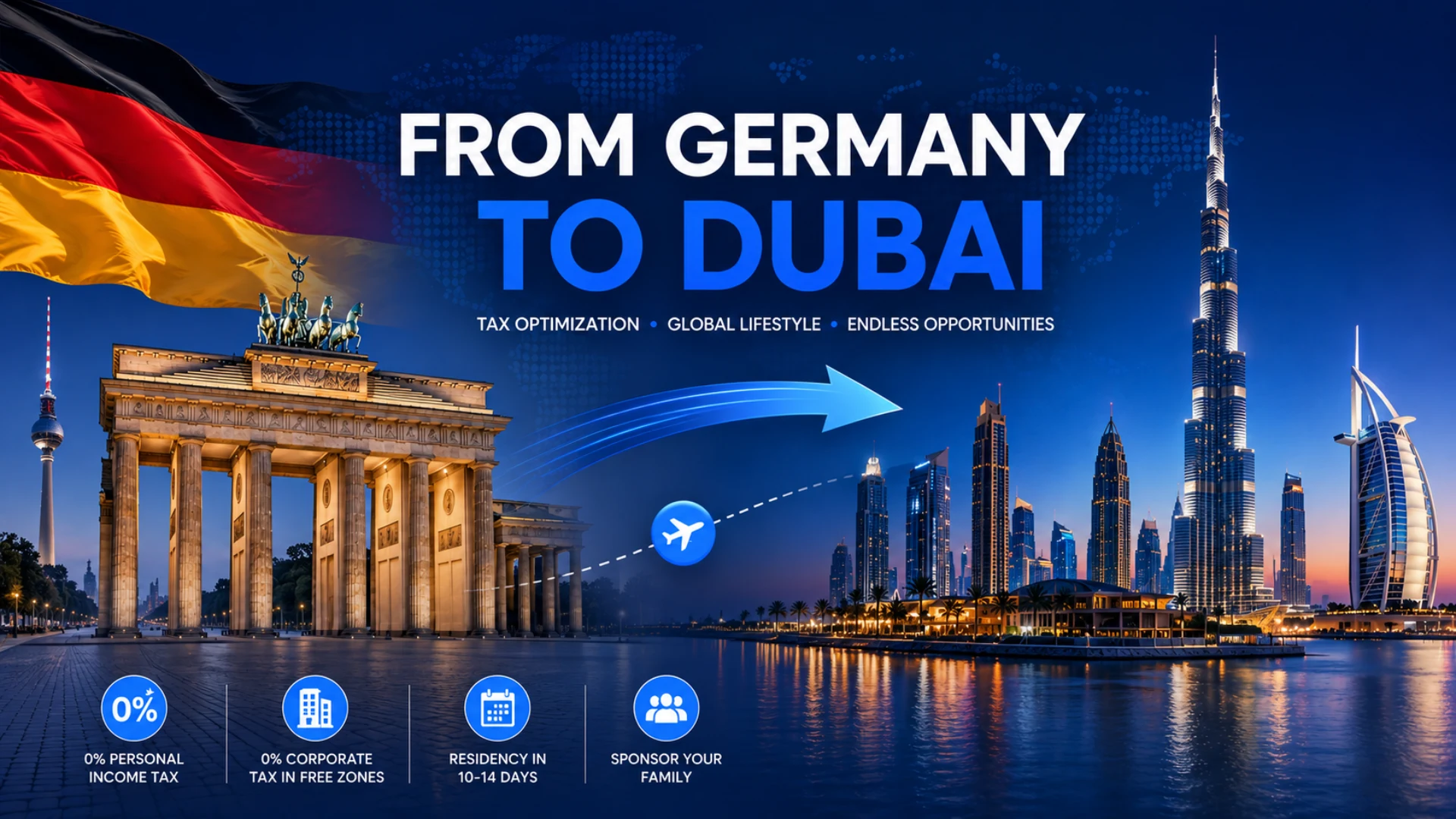
Executive Summary: German founders earning EUR 300,000 annually pay up to EUR 145,000 in tax, every year. Dubai offers 0% personal income tax and free zone corporate rates. But the exit requires careful planning: Germany’s Wegzugsbesteuerung applies to shareholders with 1% or more equity, and property left available for personal use can keep tax residency active. GenZone handles the full UAE setup, company, visa, banking, and TRC, while coordinating timing with a specialist German tax adviser.
The calls tell the story. The conversations in our consultation calls with German founders have changed significantly over the past two years. It used to be that people would enquire about Dubai out of curiosity, a casual “what if” kind of call. Now they call with urgency, and even some basic plans after a quick initial research to make the move.
As you can see, the triggers are no surprise: a top personal income tax rate approaching 48% with solidarity surcharge, corporate tax at the GmbH level running close to 30%, the dreaded Wegzugsbesteuerung exit tax that kicks in the moment shareholders try to leave the country, and a regulatory environment that has grown steadily more suffocating for globally-focused entrepreneurs.
Setting up in Dubai has emerged as the most practical answer for a very specific kind of German founder, one who earns well, operates internationally, and has quietly reached the point where staying no longer makes financial sense.
Take, for example, Prof. Dr. Markus Rothenburger, a seasoned German physician and life sciences consultant with 25 years of international experience. He relocated to Dubai with GenZone and described the process as “fully transparent, with no hidden fees and a strong solution-oriented mindset.”
Or consider Fabian Ene, the driven founder behind Fight Gecko, who made the move from Germany to Dubai and had his entire company set up in just 14 days, a timeline that would be unthinkable with most competing agencies.
This guide covers the full picture: why German founders are leaving in growing numbers, what the tax situation actually looks like on the ground, how the exit process works step by step, what you set up in Dubai, and what life genuinely looks like once you arrive.
Wegzugsbesteuerung, Tax Exit, and Moving to Dubai
The complete guide for German founders. The tax exit, the timeline, what you build in Dubai, and what the numbers actually look like.
- Free Zone: 0% tax, 100% ownership, remote in 3 to 5 days
- Mainland: trade freely in UAE, 9% above AED 375K
- Register before German Abmeldung to avoid residency gap
- Medical and biometrics: one 15-minute appointment in Dubai
- Visa stamped and Emirates ID in 7 to 10 days from arrival
- Establishes you as a UAE resident before Abmeldung
- Applied for after 90 days in UAE within 12 months
- Present to German Finanzamt alongside Abmeldung
- Does not cancel Wegzugsbesteuerung if unaddressed
Why German Founders Are Leaving
Germany’s top personal income tax rate is 45%. Add the solidarity surcharge and the effective rate for high earners sits between 47 and 48%. At the GmbH level, combined corporate tax including trade tax depending on the municipality runs approximately 29 to 31%.
For a founder earning EUR 300,000 per year through a combination of salary and distributions, the German tax system consumes roughly EUR 130,000 to EUR 145,000 annually. Over five years that is EUR 650,000 to EUR 725,000 paid to the German state.
Beyond the headline rates, Germany has become increasingly difficult for entrepreneurs in practical ways. Banking compliance requirements have grown burdensome for internationally-active businesses.
Bureaucratic processes for company formation and regulatory approvals move slowly. The regulatory direction on digital services, international payments, and energy has trended in ways that create friction for the kind of business most GenZone clients run.
Dubai offers the opposite environment. 0% personal income tax, a free zone company structure that qualifies for 0% corporate tax on eligible income, residency obtainable in under two weeks, and a city built explicitly around attracting internationally mobile entrepreneurs.
The mathematics are not subtle. For a German founder at the income levels described above, the saving in a single year covers the cost of setting up and maintaining the Dubai structure many times over.
The German Tax Exit: What It Actually Requires
Leaving Germany for Dubai is not simply a matter of registering a company in the UAE and boarding a flight. Germany has specific and legally enforceable rules about when and how tax residency ends. Getting this wrong is the most expensive mistake a German founder can make, often more expensive than the tax they were trying to leave behind.
Deregistration (Abmeldung)
The first formal step is deregistering your place of residence at the local Einwohnermeldeamt, the residents’ registration office. This is the administrative record that confirms you no longer maintain a registered domicile in Germany and is the starting point for your exit from the German tax system.
Deregistration alone is not sufficient if you continue to maintain a Wohnsitz (place of abode) or gewöhnlicher Aufenthalt (habitual abode) in Germany. If you retain a property in Germany that remains available for your personal use, even a second home or a property you own but have not actively rented out to someone else, the German tax authority can treat you as continuing to be a German tax resident regardless of your deregistration.
The practical implication: if you own property in Germany and plan to relocate to Dubai, you need to either sell it, rent it out on a formal long-term lease that removes your personal access to it, or obtain specific German tax advice on how to structure the remaining ties. This is not optional and it is not something to figure out after you have already moved.
The German Exit Tax (Wegzugsbesteuerung)
Germany applies an exit tax on departure for shareholders who hold 1% or more in a corporation’s shares. Under section 6 of the Foreign Tax Act (AStG), when a German tax resident emigrates, Germany treats the departure as a deemed disposal of those shares at fair market value and taxes the resulting gain as if the shares had been sold on the day of departure.
For founders with equity in a GmbH or shares in a growing business, this creates a tax liability at the point of exit even if they have sold nothing. The exit tax applies to the total unrealised appreciation in the shares since they were acquired.
There are deferral mechanisms available for EU-internal relocations, moving from Germany to France or Spain, for example, but relocating to a non-EU country like the UAE generally triggers the exit tax in full and it becomes payable. For founders with significant equity value, this is the single most important planning point in the entire relocation. The timing and structuring of the exit matters enormously, and specialist German tax advice before departure is not optional.
Days After Departure
Once deregistered and no longer maintaining a German Wohnsitz, you must ensure you do not spend more than 183 days per year in Germany, as extended stays can trigger the gewöhnlicher Aufenthalt test and reinstate German tax residency. Most German-origin GenZone clients aim for under 90 days in Germany per year to maintain a clear and comfortable buffer.
What You Set Up in Dubai
For German founders, the typical Dubai structure involves three components that need to be put in place in the right sequence relative to the German deregistration.
Company Registration
A UAE company, either a free zone company or a mainland company depending on your business activities, provides the foundation for UAE residency. The company sponsors your residency visa and is the legal entity through which you operate.
For most German founders running consulting, advisory, coaching, digital, or internationally-focused businesses, a free zone company is the right structure. It offers 0% corporate tax on qualifying income, 100% foreign ownership, and can be registered remotely in 3 to 5 business days. You do not need to be in Dubai to complete the registration.
Residency Visa and Emirates ID
Once the company is registered, an entry visa is applied for and you travel to Dubai to complete the medical examination and biometrics process. This is a single appointment of approximately 15 minutes. Your residency visa is then stamped in your passport and your Emirates ID is issued, typically within 5 to 7 business days.
The full process from company registration to Emirates ID in hand runs approximately 10 to 14 days. The complete step-by-step process and what each day looks like is covered in the Dubai residency guide.
Tax Residency Certificate
Once you have spent 90 days in the UAE within a 12-month period, you can apply to the Federal Tax Authority for a Tax Residency Certificate (TRC). This is the document you present to German tax authorities when they question your non-residency status, to banks that require confirmation of your tax position, and to any international institution that needs to verify where you are tax resident.
For German founders specifically, the TRC is important but it is not automatically sufficient to resolve all German tax obligations. If the Wegzugsbesteuerung applies and has not been properly addressed before departure, a UAE TRC does not cancel that liability. The exit and the Dubai setup need to be coordinated in the right sequence. Full details on the TRC process, the 90-day rule, and how day counts work are covered in the dedicated guide.
The Timeline: How a German Founder Typically Does This
Here is what a well-structured German relocation looks like in practice, based on the process GenZone has coordinated for German clients.
Month 1 to 2: German tax exit planning Engage a German tax specialist who handles international exits to assess your Wegzugsbesteuerung exposure, advise on the optimal deregistration timing, and structure any equity or business interests ahead of departure. This is the step most people want to skip and the one that costs the most when they do. Do not start the Dubai side before this is at least scoped.
Month 2 to 3: Dubai company registered remotely While still in Germany, register your UAE company remotely. GenZone handles the full application with the relevant free zone authority. Trade licence is typically issued within 3 to 5 business days.
Month 3: Travel to Dubai, complete the full visa process One trip of 7 to 10 days handles everything: entry visa, medical appointment, biometrics, Emirates ID collection, personal bank account, and corporate bank account application. By the end of this trip you are a UAE resident with documentation in hand.
Month 3 to 4: German deregistration (Abmeldung) Once UAE residency is established and documented, complete the formal Abmeldung at your local Einwohnermeldeamt. Timing this after UAE residency is in place ensures there is no gap in residency status that tax authorities on either side could use against you.
Month 4 to 6: Tax Residency Certificate application Once 90 UAE days have been accumulated, apply to the FTA for the TRC. Present this alongside your Abmeldung documentation as your formal evidence of changed tax residency. Together they make a strong and coherent case.
Ongoing: Day management Track UAE days carefully. Most German-origin clients aim for 100 to 120 UAE days per year and stay well under 90 days in Germany. A simple spreadsheet tracking every entry and exit date across both countries is sufficient and forms part of your evidence record.
German Founders Who Have Made the Move
The results speak for themselves, and GenZone has the case studies to back them up.
Prof. Dr. Markus Rothenburger is a German medical professional with 25 years of clinical and leadership experience across cardiovascular surgery, intensive care, and global pharmaceutical affairs. When he decided to establish his Dubai-based life sciences consultancy NexaBio Consulting, he needed a partner who could handle company formation, Golden Visa, banking, real estate acquisition, and ongoing accounting under one roof. Read how GenZone managed his complete UAE journey.
Fabian Ene is the founder of Fight Gecko, a combat sports brand and coaching operation that works with some of the world’s highest-profile entrepreneurs. He relocated from Germany to Dubai and had his company registered, his visa processed, and his employee visas in place within 14 days. Read how GenZone set up Fabian’s Dubai company in 14 days.
Two very different businesses, two very different founder profiles, the same outcome: a fully operational Dubai structure set up quickly, correctly, and without the founder needing to navigate the process alone.
What Dubai Actually Looks Like for German Founders
The practical experience of Dubai for German founders is frequently better than expected and occasionally different in ways worth being honest about.
What is genuinely better: The physical infrastructure is exceptional. Roads, airports, internet connectivity, government digital services, private healthcare, and public safety are all at a level that most German cities match in some areas but not across the board. The tax saving is real and immediate. The entrepreneurial community in Dubai is dense and internationally-minded in a way that is unusual for a city of its size. Everyone around you is building something.
Flight connectivity from Dubai to Germany is outstanding. Frankfurt, Munich, Dusseldorf, Hamburg, Berlin, and Stuttgart all have multiple daily connections. For founders who need to visit clients, family, or partners in Germany regularly, Dubai is logistically well-placed. You can leave Dubai Sunday evening and be in a Munich meeting by Monday morning.
What requires adjustment: The summer months of June through September are genuinely hot. Most residents treat this period as extended travel season and spend meaningful time outside the UAE. For German founders managing their day counts this is actually useful: summer in Europe, autumn and winter and spring in Dubai, works well for both lifestyle and presence management.
Arabic is the official language but English is the working language of business and daily life in Dubai. Almost all government services, commercial interactions, and professional communications operate in English. German is not required or expected.
Cost of living: Dubai is not cheap. It is broadly comparable to Munich in many categories and more expensive in others, particularly private schooling. However, on a net-of-tax basis, most German founders find their effective purchasing power increases significantly despite the higher gross living costs. Keeping an additional EUR 130,000 per year changes the personal finance picture substantially regardless of what rent costs.
Bringing Your Family
UAE residency visa holders can sponsor their spouse and children for their own UAE residency visas and Emirates IDs. The process mirrors the primary applicant’s: medical examination, biometrics, Emirates ID. Family members can be added at the outset or after the primary applicant’s residency is established.
For families with children, Dubai has a strong range of international schools. German curriculum international schools operate in Dubai and are popular among German families who want continuity in their children’s education while making the transition. School fees range from AED 25,000 to AED 80,000 per year depending on the school and year group.
The Golden Visa route, available through a UAE property purchase of AED 2,000,000 or more, provides a 10-year residency visa and extends sponsorship rights to parents and in some cases dependent siblings, broader than the standard 2-year company-based visa.
What About a US LLC?
Some German founders operating businesses that need US banking, Stripe access, or PayPal alongside their Dubai structure add a US LLC as a second entity. It is not a requirement and most clients do not need it, but for founders selling to US-based clients or needing US payment infrastructure it is a common and practical combination. GenZone sets up US LLCs for non-resident founders across 50 countries and the two structures work well together.
How GenZone Handles This for German Clients

GenZone has worked with founders and professionals from Germany across a range of industries including life sciences, combat sports and coaching, technology, consulting, and financial services. The process we manage is the UAE side: company registration, visa processing, banking introductions, Tax Residency Certificate application, and ongoing annual compliance through our accounting and tax team.
What we do not handle is the German exit tax advice. That requires a specialist in German tax law, and we are transparent about that from the first call. What we do is connect you with the right advisors in Germany and coordinate the timing between their work and ours, so the Wegzugsbesteuerung assessment, the deregistration, and the Dubai setup all happen in the right sequence without gaps or conflicts.
The result is what Dr. Rothenburger described: a fully coordinated, end-to-end process with no hidden fees and no waiting on multiple providers who do not communicate with each other.
Book a free strategy call with GenZone to talk through your specific situation. We will be direct about what applies to you and what does not, and we will tell you exactly what the process looks like before you commit to anything.
Frequently Asked Questions
Do I need to sell my German property before moving to Dubai?
Not necessarily, but it must not remain available for your personal use in a way that constitutes a German Wohnsitz. Renting it out on a formal long-term lease to a third party is the most common approach. Get specific advice from a German tax specialist on the right structure for your situation.
Does the Wegzugsbesteuerung apply to everyone?
No. It applies to shareholders holding 1% or more of a corporation’s shares. If you operate as a sole trader or through a structure without equity shares, it may not apply. The specific circumstances require individual assessment.
Can I keep my German bank accounts after moving?
Maintaining German bank accounts does not by itself maintain German tax residency. However, it is one of the ties that contributes to the overall picture the tax authority will assess. Banks may also require updated tax residency documentation once your UAE residency is established.
How long does the full process take?
UAE company registration is 3 to 5 business days and done remotely. The full visa process from arrival in Dubai is 7 to 10 days. German deregistration timing depends on your specific situation and your tax adviser’s guidance. Most clients complete their UAE setup in the same month they deregister in Germany or in the month immediately following.
Can I still visit Germany after moving to Dubai?
Yes. Stay under 183 days per year in Germany, with most clients aiming for under 90, to avoid triggering the gewöhnlicher Aufenthalt test. Document your UAE presence throughout the year as your evidence record.
What about German health insurance?
Your existing Gesetzliche Krankenversicherung (GKV) or Private Krankenversicherung (PKV) will need to be reviewed and likely suspended or cancelled as part of your deregistration. UAE private health insurance is mandatory for visa holders and typically costs AED 4,000 to AED 12,000 per year for a single adult depending on age and coverage level. For families, AED 15,000 to AED 40,000 per year is a realistic budget.
