








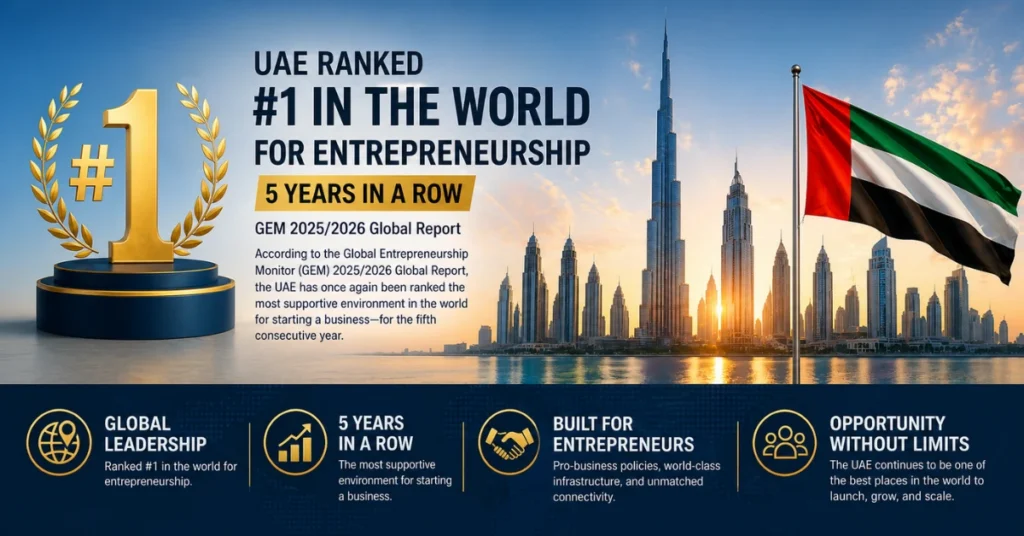
Despite ongoing regional geopolitical tensions, shifting economic alliances, and global uncertainty, the United Arab Emirates continues to demonstrate exceptional strength across the key indicators that define a world-class entrepreneurial economy. The evidence is now official: according to the Global Entrepreneurship Monitor (GEM) 2025/2026 Global Report, the UAE has been ranked the most supportive environment in the world for starting a business – for the fifth consecutive year.
That kind of sustained, consistent leadership at the global level does not happen by accident. It is the outcome of deliberate national choices, systematic infrastructure investment, and a clear-eyed commitment to positioning entrepreneurship at the heart of economic strategy. And in the current global climate, this achievement carries even more weight.
The World These Entrepreneurs are Building In
Before jumping to an analysis of what makes the UAE stand out, it is worth having a look at what the report describes as the global backdrop. The GEM 2025/2026 report opens by characterising the current moment as one defined by overlapping disruptions: “geopolitical fragmentation, climate-driven instability, rapid automation, demographic shifts and the reconfiguration of supply chains.”
In that environment, many economies are becoming more cautious – capital slows, risk appetite declines, and entrepreneurial energy often contracts. The report is frank about the challenges facing most countries: across 53 participating economies, 32 out of 48 recorded a higher share of adults reporting income declines than increases in 2025.
That is significant context. Building a business in a world where household purchasing power is shrinking is not easy, and many economies are struggling to provide the structural support entrepreneurs need to survive those pressures.
The report also makes a pointed observation about one of the most common failure modes in global entrepreneurship: “many businesses are being born but too few are surviving long enough to anchor durable employment, innovation and export capacity.” Startup formation is high in many markets, but the transition from early-stage venture to durable, job-creating business is where most ecosystems break down.
The gap between launch and longevity is, the report argues, not a problem of individual ambition – it is a problem of policy and infrastructure. Against this backdrop, the UAE’s sustained top ranking is not just impressive. It is meaningful.
Entrepreneurship is no Longer a Side Metric
One of the most important conceptual shifts in this year’s GEM report is how it frames entrepreneurship itself. The report argues that the role of entrepreneurship in national economies has fundamentally changed. In the foreword, GEM Executive Director Aileen Ionescu-Somers writes that “entrepreneurship is no longer simply a marker of economic dynamism: it has become a central pillar of national resilience.”
This repositioning matters for how governments, investors, and founders should think about where they operate. The question is no longer simply whether a country has a large market or abundant natural resources. The increasingly relevant question is whether an economy can enable individuals to start businesses, support those businesses through uncertainty, and convert that entrepreneurial energy into durable, long-term economic value.
That is the lens through which the GEM rankings should be read – not as a list of the most active startup scenes, but as an assessment of which economies have built genuine systems to translate entrepreneurial ambition into national prosperity.
The UAE is One of Only Four Economies Meeting the Full Standard
Among the most significant findings in this year’s report is a statistic that deserves to be read carefully: only 4 out of 53 economies meet or exceed the “sufficiency” threshold across all 13 Entrepreneurial Framework Conditions. These are the structural pillars that GEM uses to measure the quality of an entrepreneurial ecosystem – covering access to finance, government policy, regulatory efficiency, infrastructure, education and talent development, and market openness, among others. The UAE is one of those four, alongside India, Lithuania, and Saudi Arabia.
In practical terms, this means that across every one of those dimensions, the UAE performs at a level that national experts consider adequate or better for supporting entrepreneurial activity. That is not a common achievement. As the report notes, only 16 of 53 economies have an entrepreneurial environment rated by national experts as sufficient or better in aggregate. Most countries have clear weak spots – areas where deficiencies in regulation, capital access, or education slow down even motivated founders. The UAE has systematically addressed each of these.
The report is explicit about the implications: “entrepreneurship is a system, not an accident. The entrepreneurial outcomes observed in this report are not purely the product of ambition, creativity or necessity. They are the reflection of national choices – about education systems, finance architectures, regulatory environments, workforce development, digital infrastructure and cultural attitudes towards risk and failure.”
In the UAE, those choices have been made – consistently and at scale.
More Than One in Five Adults is Actively Starting a Business
The GEM survey measures what it calls Total Early-stage Entrepreneurial Activity (TEA) – the share of adults between 18 and 64 who are actively starting or running a new business. In most upper-income economies, this number tends to be relatively modest, because affluent labour markets typically offer well-paying employment alternatives that reduce the push toward self-employment.
The UAE’s TEA figure defies that pattern. The report identifies the UAE as one of a small group of upper-income economies – alongside Saudi Arabia, Canada, and the United Kingdom – where more than one in five adults are engaged in early-stage entrepreneurial activity. That is a remarkable figure for a high-income economy, and it speaks to the depth of entrepreneurial culture that has taken hold.
What matters more than the volume, though, is the character of that activity. The GEM report distinguishes carefully between two types of entrepreneurship: necessity-driven, where people start businesses because formal employment is scarce; and opportunity-driven, where founders are motivated by growth ambition, market opportunity, and access to resources.
In low and middle-income economies like India, necessity-driven entrepreneurship tends to dominate. In the UAE, the opposite is the fact. Founders are not building businesses because they have no other option. They are building because the environment makes it genuinely attractive to do so – and because the infrastructure exists to support serious ambition.
The report also notes that in the UAE, four or more adults are starting or running a new business for every one established business owner – a ratio that signals a highly dynamic, forward-moving entrepreneurial culture, not one in a state of stagnation.
Policy, Regulation, and the Architecture of Execution
The GEM report returns repeatedly to a central argument: entrepreneurial outcomes are shaped by policy choices, not luck. The UAE’s standing in the report is inseparable from the decisions that have been made at the government level over the past decade and a half.
Business formation in the UAE is streamlined to a degree that sets a benchmark for the region and, in many respects, the world. Bureaucratic friction has been systematically reduced. Regulatory frameworks are reviewed and updated on a regular basis to keep pace with how businesses actually operate.
On top of that, the UAE free zones offer internationally competitive legal and tax structures for companies at every stage of growth. These are not marginal advantages – they compound across the lifecycle of a business, reducing the friction that kills ventures in their early stages elsewhere.
Access to capital has historically been one of the biggest global constraints on entrepreneurship. The GEM report identifies entrepreneurial finance as one of the most binding conditions for business survival and scaling globally. In the UAE, this constraint is substantially reduced.
A mature ecosystem of government-backed initiatives, venture capital networks, sovereign wealth activity, and private investment channels gives founders options at multiple stages of growth – from early-stage grants and accelerators through to Series A and beyond.
Infrastructure, too, operates at a level that enables businesses to compete internationally from day one. Digital connectivity, logistics networks, and physical infrastructure are not bottlenecks in the UAE – they are competitive advantages. A business incorporated in Dubai or Abu Dhabi has immediate access to air, sea, and digital infrastructure that a founder in most other parts of the world would take years to reach.
AI Readiness and the Digital Frontier
A major theme in this year’s GEM report is the divergence between economies on digital transformation and artificial intelligence adoption. The authors write that “digital transformation – particularly AI diffusion – will increasingly differentiate the economies that sustain entrepreneurial success from those that risk stagnation, widening the gaps between entrepreneurs who can harness advanced technologies and those who cannot.”
This is a serious warning. In 19 of 48 GEM economies, fewer than one in three new entrepreneurs expect AI to become very important to their business in the near future. The majority of entrepreneurs with high AI expectations are concentrated in a small group of economies – and the UAE is explicitly one among them.
The report well identifies the UAE, alongside Brazil, Angola, Thailand, Costa Rica, and Chile, as economies where a majority of early-stage entrepreneurs already anticipate AI becoming central to their operations.
That positioning has real consequences. The next phase of global entrepreneurship will be defined not just by who can start businesses, but by who can scale them efficiently using advanced tools. Economies where founders understand, adopt, and build with AI will produce different kinds of businesses – more productive, more scalable, more resilient – than economies where digital literacy lags. The UAE is clearly on the right side of that divide.
This is not coincidental. National AI strategies, investment in digital infrastructure, and policy support for tech adoption have all contributed to an environment where founders are not just aware of AI’s potential – they are actively incorporating it into their business models.
Talent Mobility and the Global Hub Advantage
Another notable insight from the GEM 2025/2026 report that resonates strongly for the UAE is on the subject of talent. The foreword notes that “talent is becoming more mobile, and migrants – when enabled – serve as bridges to new markets and sources of innovation.”
The UAE has built one of the world’s most effective environments for attracting international entrepreneurial talent. With over 88% of its population comprising expatriates, the country is by definition a laboratory for cross-border entrepreneurship. Founders who set up in the UAE bring with them networks, market knowledge, and business relationships spanning Asia, Africa, Europe, and beyond. That international connectivity is not a side benefit – it is part of the product.
Regulatory frameworks that support foreign business ownership, visa structures that accommodate long-term residency for entrepreneurs and their families, and a tax environment that allows founders to retain and reinvest their returns all contribute to an environment that actively competes for global talent. The result is an entrepreneurial ecosystem that looks unlike any other in the region: diverse in origin, global in orientation, and deep in accumulated expertise across sectors.
What the Data Says About Resilience
One of the more striking findings in this year’s report, relevant specifically to the UAE, concerns what happens when businesses in different economies exit. In most markets, business exit tends to mean closure – the venture failed, and the founder moves on, often discouraged.
In a select group of economies, however, a different pattern emerges: a significant share of businesses that “exit” continue under new ownership or management. The UAE is among these economies. In the UAE and a handful of other high-performing markets, more than half of businesses that exit continue operating in some form. That is a marker of ecosystem health – it means businesses built in the UAE are durable enough to survive changes in ownership, and that markets for business transfer are mature enough to enable clean transitions.
At the same time, the GEM data shows that entrepreneurs in the UAE who have exited a business are among the most likely in the world to intend to start again. The lived experience of building and exiting a business in the UAE, even when difficult, does not extinguish entrepreneurial ambition – it feeds it. That is the hallmark of a resilient ecosystem.
The Fifth Ranking in Context
It is worth pausing on the number itself: five consecutive years at the top of the GEM rankings. Across 53 economies, through a pandemic, a period of global inflation, ongoing regional tensions, and the most rapid technological disruption in a generation, the UAE has maintained its position as the world’s most supportive environment for starting a business.
The GEM report states plainly: “For the fifth year in a row, the United Arab Emirates is rated the most supportive environment for a new business.”
Sustaining that position is harder than reaching it. First-time rankings can reflect a moment. Five consecutive rankings reflect a system – one that continues to perform, improve, and adapt as the world changes around it.
What All This Means if You’re a Founder
The GEM report ultimately delivers a message that every serious founder should consider: environment shapes outcomes. The report is explicit on this point – entrepreneurial success is not determined solely by individual effort. It is systemically produced. Founders who choose their operating environment wisely are giving themselves a structural advantage that compounds over time.
Where you build your business affects how fast you can execute, what capital is available to you, what markets you can reach, how much regulatory friction you navigate, and how your business is perceived by partners and clients globally. These are not soft factors – they translate directly into speed, cost, and survival probability.
The UAE combines policy clarity, financial access, global connectivity, digital infrastructure, and a pro-growth regulatory environment in a way that is genuinely difficult to replicate. For founders thinking about where to establish, expand, or redomicile their operations, the case is not abstract. It is documented, measured, and ranked.
Building in Dubai – With the Right Structure
The opportunity is clear. But in an ecosystem as sophisticated as the UAE, execution matters enormously. Choosing the right jurisdiction, free zone, or mainland structure can affect everything from your tax position to your ownership rights to your eligibility for government programmes and funding.
At GenZone, we work with founders globally (we have served 1,100+ clients from 50+ countries as of writing this) to establish UAE-based business structures, optimise for international operations, and navigate the regulatory and compliance landscape from day one. We help serious founders enter the UAE market correctly – not just quickly – so that the structural advantages the ecosystem offers are fully accessible to you.
If you are considering establishing a presence in Dubai, or want to understand what the GEM findings mean for your specific situation, reach out to the GenZone team by booking a call below.
Source: GEM (Global Entrepreneurship Monitor) (2026). Global Entrepreneurship Monitor 2025/2026 Global Report: From Uncertainty To Opportunity. London: GEM.
