





There’s a version of this conversation on almost every discovery call. Someone has read that the UAE has 0% personal income tax, has maybe browsed a few expat forums, and has arrived with a mental model of how UAE residency and tax residency work that’s roughly 80% right and 20% expensive. The 20% is what we spend most calls correcting.
We pulled the most common misunderstandings, the ones that show up not just on our calls but across expat forums and the UAE tax press, and broke down what’s actually true underneath each one.
UAE Residency vs Tax Residency: The Myths That Cost Founders
An Emirates ID is not a Tax Residency Certificate. A UAE visa does not end your home country tax obligations. Here is what actually determines each status.
Myth #1: “I’m moving to a 0% tax country, so I won’t owe tax anywhere.”
This is the most common assumption, and it’s the one that causes the most damage, because it’s not really about the UAE at all. It’s about what your home country still considers true.
The UAE not taxing your income doesn’t obligate any other country to agree. The United States taxes citizens on worldwide income no matter where they live, full stop. Moving to Dubai doesn’t change that filing obligation, though tools like the Foreign Earned Income Exclusion can reduce what’s actually owed if you qualify and structure correctly. Most other Western countries don’t tax by citizenship, but they tax by residency, and residency there isn’t decided by where you’d rather be taxed.
Canada is the clearest example of how strict this can get. Under the Canada-UAE tax treaty, non-Canadian-national founders can’t even invoke the standard treaty tiebreaker rules to resolve a dual-residency dispute. In practice, that means a Canadian founder can remain a Canadian tax resident no matter what their UAE tax residency certificate says, a hard stop that catches people who otherwise did everything correctly on paper. Other countries, including the US, UK, and Germany, generally do use the standard tiebreaker approach, but apply it strictly based on real-life facts, not the existence of a certificate.
The fix isn’t complicated, but it is active: you generally have to deliberately exit your old tax residency, not just acquire a new one and assume the first cancels out automatically. That process looks different depending on your country of citizenship and residence, which is why proper planning before relocating is essential.
Myth #2: “If I just count my 183 days correctly, I’m covered.”
The 183-day rule gets treated like the whole test. It’s actually the last of four tiebreakers most tax treaties use to decide which country wins when two countries both claim someone as a resident, and it only gets reached if the earlier tests don’t already settle the question.
Before any day-counting happens, treaties typically look first at where your permanent home is, then at where your “centre of vital interests” sits, broadly, where your family lives and where your financial life is centred. Only if both of those are ambiguous does the count of days (habitual abode) come into play, followed by nationality as a final tiebreaker if even that doesn’t resolve it.
This is why founders who track their days carefully, hold a UAE tax residency certificate, and have an active UAE company can still get assessed as tax residents back home. The certificate and the day count never mattered, because the first two tests, permanent home and centre of vital interests, already pointed to where their family and financial life actually were.
Myth #3: “If I stay under 90 days in the UAE, I won’t owe Corporate Tax on my business here.”
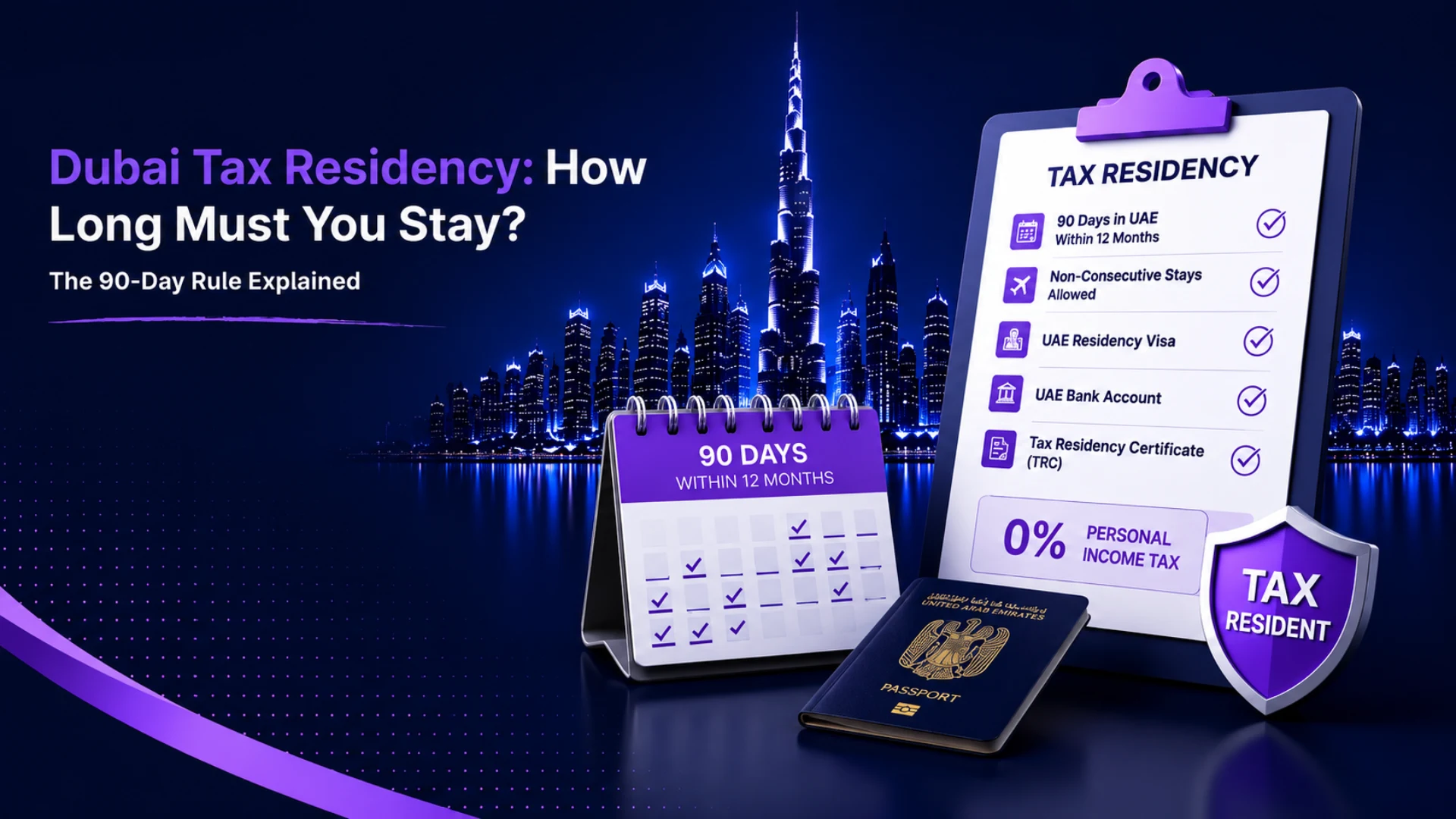
This is a different question from the treaty tiebreaker above. It’s about the UAE’s own domestic Corporate Tax law, not a dispute between two countries. The UAE does have day-count tests for personal tax residency: broadly, 183 days in a 12-month period is one path to UAE tax residency, and 90 days is another path if you also meet additional conditions (a permanent UAE home, or UAE nationality/residency, or carrying on business/employment here).
The mistake is assuming those same day-count thresholds also decide UAE Corporate Tax exposure. They don’t. Corporate Tax determines “resident person” status separately, based on whether you’re conducting a specified business in the UAE, and an individual can be on the hook for Corporate Tax on that business activity even while staying well under 90 days and having no permanent home here. UAE tax advisors have had to publicly correct this exact confusion, because the two systems share the word “resident” but run on different logic.
Myth #4: “My Free Zone company automatically gets 0% Corporate Tax.”
The 0% rate for Free Zone companies isn’t automatic just because the license says “Free Zone.” It applies to entities that qualify as a “Qualifying Free Zone Person”, broadly, you need genuine substance (real presence, not a brass-plate address) and income that falls into qualifying categories. Step outside that, by doing meaningful mainland-facing business through the Free Zone entity, for instance, and the qualifying treatment can be at risk for that income, or the whole structure can warrant a second look. The license type is the starting point, not the guarantee.
Myth #5: “Free Zone, Mainland, and Offshore are basically the same thing with different price tags.”
This shows up constantly in setup forums, and it’s an expensive simplification. The three structures aren’t price tiers of the same product:
- Mainland companies can trade directly across the UAE domestic market and bid on government contracts, but they’re squarely inside the standard Corporate Tax regime on both UAE and foreign-sourced income tied to the business.
- Free Zone companies get the potential for 0% qualifying income (subject to Myth #4 above), but they’re generally restricted from operating directly in the mainland market without separate licensing or a branch.
- Offshore companies are built for holding assets or international invoicing with no UAE physical presence, and critically, they can’t trade within the UAE and can’t sponsor a residency visa at all.
People pick based on price or speed and find out the restriction later, when they actually try to invoice a UAE client from an Offshore entity, or sponsor a visa from one, and discover the structure was never built to do that.
Myth #6: “My Emirates ID and UAE bank account prove I’m a UAE tax resident.”
These are real, necessary steps, but they’re residency infrastructure, not tax residency proof. The document that actually establishes UAE tax residency for treaty purposes is a Tax Residency Certificate, issued by the Federal Tax Authority on its own separate criteria. Plenty of people hold an Emirates ID and a functioning UAE bank account for years without ever applying for, or qualifying for, a TRC.
And even once you have the certificate, it’s not a finish line on its own. A TRC gives you real standing in a treaty dispute, but if the facts of daily life, where your family lives, where your main home is, where your money is managed, still point to your old country, the certificate alone doesn’t necessarily win that dispute. The paperwork has to match the substance. It doesn’t replace it.
One more distinction worth knowing: your company vs. you
A company incorporated in the UAE is automatically a UAE tax resident. That part really is simple, and it’s true regardless of where the owner personally lives. The owner is a separate question entirely, governed by the multi-factor personal tests above. Founders regularly assume that because the company “passed” UAE residency, they personally did too, or that getting their own residency sorted automatically extends to the company. Neither assumption holds. Each is decided on its own.
Myth #7: “Once I get my UAE residency (or even my tax certificate), my home country residency ends automatically.”
A UAE residency visa, and even a UAE tax certificate, are things the UAE grants you. Neither one obligates your home country to agree that your tax residency there has ended. That determination is made entirely by your home country’s own rules, which for most Western countries comes back to the same ties tested in Myth #1 and #2: permanent home, family, and centre of vital interests.
Closing that loop takes active, visible substance, not just paperwork:
- Relocating family and dependents to Dubai, not just yourself
- Keeping residency visas, school enrollment, and medical coverage active locally
- Banking, investing, and spending primarily in Dubai
- Avoiding significant financial or personal ties left behind in the old country
This is also why the right time to plan this is before the move, not two years later when a home tax authority opens a residency review and starts asking where your family actually lives.
Final Thoughts
There isn’t one “tax residency” status. There are several, decided independently: your UAE personal residency, your UAE company’s residency, your UAE Corporate Tax position, and your home country’s view of your personal residency, which itself may run through a treaty tiebreaker test.
Treating any two of these as automatically linked is where the expensive surprises come from. The founders who get this right map all of them explicitly, on purpose, instead of assuming one event, a flight, a visa, a certificate, settled everything at once.
This is general information, not personalized tax or legal advice. UAE Corporate Tax, UAE tax residency rules, treaty tiebreaker rules, and the rules in your home country all evolve, and your specific situation may not match the general patterns above. Confirm the details with a qualified advisor before making decisions based on them.
If you want to map out exactly where you stand on UAE residency, UAE tax residency, and your home country’s rules before you commit to a structure, book a free Dubai Setup consultation with GenZone and we’ll walk through all of it with you, not just the one piece that’s easy to sell.