


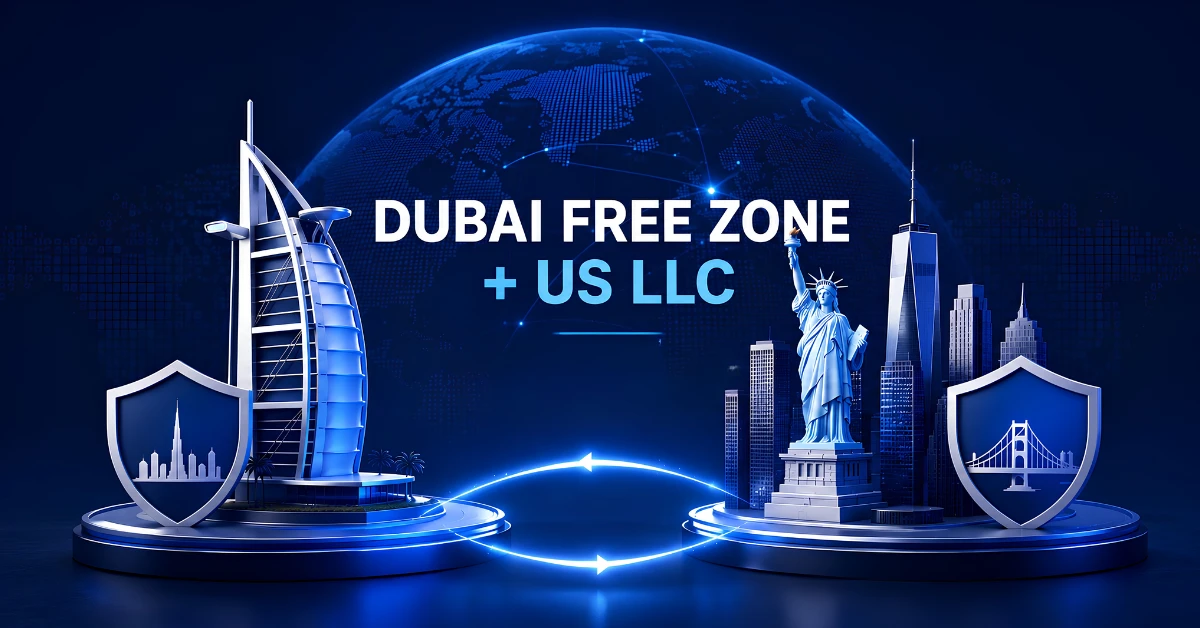

Executive Summary: Dubai Free Zone founders running global businesses often hit friction with US payment processors, banking platforms, and affiliate networks. The fix is a dual structure: the UAE Free Zone company owns a US LLC, which handles US-facing operations with no federal tax liability for non-residents. Together, the two entities cover payment processing, USD banking, platform access, and tax efficiency across both jurisdictions – set up correctly from day one, with full ongoing compliance handled.
If you’ve set up a Dubai Free Zone company and you’re selling to customers in the US, processing payments through platforms like Stripe, or working with US-based affiliate networks, there’s a good chance you’ve already hit a wall. Payment rejections. Higher fees. Platform approvals that never come. The problem usually isn’t your business – it’s your structure.
That’s what this article covers: why so many international founders running Dubai Free Zone companies are pairing them with a US LLC, exactly how the structure works, what it means for your taxes, and how GenZone can set up both sides of that structure for you – end to end.
And we’re not just advising on this from the outside. GenZone is a Dubai Free Zone company, headquartered in Business Bay – and we’ve opened a US LLC ourselves for exactly the reasons outlined in this article. We went through the same process our clients go through, hit the same friction points, and built the same solution. What follows is everything we learned.
Dubai Free Zone + US LLC
Why Smart Founders Run Both
How pairing your UAE company with a US LLC solves payment friction, unlocks US banking, and gives you a globally complete business structure.
by GenZone
structure live
foreign-owned LLC
for non-residents
- UAE tax residency
- 0% personal income tax
- 0% corporate tax (qualifying)
- UAE banking and SWIFT
- Economic owner of LLC
- Stripe, PayPal, US banking
- Amazon, TikTok Shop access
- No US federal tax liability
The Problem With Operating Global From a UAE Entity Alone
A UAE Free Zone company is an exceptional base for running a global business. Zero corporate tax on qualifying income, 100% foreign ownership, fast setup, and world-class banking access. It’s why thousands of founders across 50+ countries choose Dubai as their operational home.
But here’s what a lot of founders discover after they’re up and running: certain platforms, payment processors, and financial systems treat UAE-registered companies as foreign merchants – and that classification comes with real costs.
When you process payments through Stripe, PayPal, or similar platforms using a UAE entity and most of your customers are in North America or Europe, you can run into:
- Higher payment failure and card decline rates
- Elevated processing fees compared to domestic US merchants
- Difficulty getting approved by US-centric affiliate networks
- Friction accessing platforms like Amazon US, TikTok Shop, and Shopify Payments
- Limited options for US banking infrastructure
None of this is a reflection of your business quality. It’s simply how the US financial system treats non-US entities. Credit card networks and payment processors are significantly more favorable to domestic US merchants – especially for digital products, subscriptions, and online services.
The fix is cleaner than most people expect.
The Dual Structure: How a US LLC Fits Into a Dubai Setup
The structure that solves this is straightforward. You already own your UAE Free Zone company. That Free Zone company then owns a US LLC – registered in the US as a foreign-owned entity.
Here’s how it maps out:
You (Dubai Resident) → own → UAE Free Zone Company → owns → US LLC
The US LLC acts as the operational layer – the entity that faces US customers, processes US payments, and integrates with US platforms. The UAE Free Zone company is the economic owner – where profits ultimately flow and where your tax residency sits.
Because the LLC is owned by a foreign entity (your UAE company) and has no physical presence inside the United States, it functions as a pass-through for US tax purposes. Income flows upward to the UAE entity, not to the US tax system.
The Free Zone company handles the economics. The US LLC handles the infrastructure. Together, they give you the best of both worlds.

Why This Structure: The Two Core Benefits
1. Better Payment Processing and Platform Access
When your US LLC is the merchant on record with Stripe, PayPal, or any US payment processor, you’re operating as a domestic US merchant – not a foreign one. That distinction matters enormously.
Approval rates go up. Decline rates drop. Processing fees are lower. And platforms that previously rejected or restricted your UAE entity – from US affiliate networks to Amazon’s US marketplace – become far more accessible.
For any founder whose revenue is primarily coming from US or European customers, this alone can be worth the entire cost of adding the structure.
2. Access to US Banking and Financial Infrastructure
The United States remains one of the most established financial jurisdictions in the world. With a US LLC and EIN in place, you can open real US business bank accounts – with USD wires, debit card access, and seamless integration with platforms like Stripe, PayPal, Amazon, and Shopify.
This gives you a second financial rail alongside your UAE banking setup. Rather than depending on a single jurisdiction, your business has redundancy: UAE banking for regional and SWIFT-based transactions, and US banking for dollar-denominated digital commerce.
For founders running affiliate businesses, subscription models, or any digital products sold to US audiences, having a US bank account for payouts is often not optional – many platforms simply won’t send payments anywhere else.
Who This Structure Is Ideal For
This dual setup is particularly well-suited for:
- Online business owners with a significant share of US or European customers
- E-commerce founders selling on Amazon US, Shopify, Etsy, or similar platforms
- SaaS and subscription businesses processing recurring payments via Stripe or Braintree
- Affiliate marketers working with US-based networks that require US banking for payouts
- Digital creators and coaches whose audience is predominantly based in North America
- Anyone who has hit payment processing friction with a UAE-only structure
If your business operates purely within the UAE or the GCC, you may not need a US LLC at all. But if you’re running a global digital operation from Dubai, this structure is almost certainly worth examining.

The Tax Picture: What You Actually Owe (and Where)
Tax is the question most founders get wrong about this structure – usually because of how it gets discussed online. Here’s the accurate picture.
US Federal Tax
A foreign-owned single-member LLC – where the sole member is your UAE Free Zone company – is classified as a disregarded entity for US federal tax purposes. This means the LLC itself is not subject to US federal or state corporate income tax, provided it has no physical presence inside the United States (no US office, no US employees, no US-based inventory or real estate).
Selling products or services to US customers does not create this presence. Running your online business, processing payments, and holding funds through the LLC – none of that triggers US corporate tax liability. The profits pass through to the foreign owner (your UAE company) and are treated under UAE tax rules from that point.
UAE Corporate Tax
The UAE introduced a 9% corporate tax rate in 2023 for businesses above the qualifying free zone threshold. Adding a US LLC does not change or reduce what you owe under UAE tax rules. The income generated through the LLC flows to your UAE Free Zone company and remains part of your UAE taxable entity. You cannot use the US LLC to bypass UAE corporate tax obligations.
Free zone companies on qualifying income continue to benefit from the 0% rate – but that qualification is about how your UAE company is structured and what activities it conducts, not about adding a US layer on top.
Withholding Tax: An Important Nuance
One area where founders often make incorrect assumptions is US withholding tax. Certain US-source income streams – including YouTube AdSense revenue generated from US viewers and certain US affiliate commissions – are subject to a 30% US withholding tax for UAE-resident beneficial owners.
The UAE does not currently have a tax treaty with the United States. This means the full 30% withholding rate generally applies. Importantly, forming a US LLC does not eliminate this withholding obligation. Withholding tax is determined by where the beneficial owner of the income is tax-resident – not where the LLC is registered. If you’re tax-resident in the UAE, the withholding position stays the same regardless of whether a US LLC sits in the chain.
Annual US Filing Requirements
Even with no US tax liability, foreign-owned single-member LLCs must meet annual federal filing requirements. These include:
- Form 5472 + Pro Forma 1120: Informational returns reporting transactions between the LLC and its foreign owner, due by April 15th each year. Missing this filing carries a penalty of $25,000 or more.
- State Annual Report: In Wyoming, this is a $60/year filing confirming your company details are current.
- Beneficial Ownership Information (BOI) Report: Required under US anti-money laundering regulations, confirming who the actual beneficial owner of the entity is.
These filings are not complex, but they must be done on time and done correctly. GenZone’s Done-For-You packages handle federal and state filings as part of the service – so nothing falls through the cracks.

Choosing the Right US State: Wyoming vs Delaware
As a non-US resident, you can form an LLC in any US state. In practice, two states stand out for international founders: Wyoming and Delaware.
Wyoming offers:
- Low annual fees (approximately $60/year state filing)
- Strong privacy protections – member information is not publicly listed on state records
- Zero state income tax
- A straightforward, low-cost compliance structure
Delaware is the preferred choice when:
- You’re planning to raise institutional venture capital (investors often require Delaware C-Corps or LLCs)
- You expect to do significant business with large US enterprises that prefer Delaware entities
- You have a longer-term plan to convert to a C-Corp structure
For most online business owners, coaches, e-commerce founders, and affiliate marketers operating from Dubai, Wyoming is the cleaner and more cost-effective option. GenZone helps you evaluate which state makes sense for your specific business model and goals – not just which one is cheapest today.
What You’ll Need to Set Up the US LLC
The essential components for a properly functioning US LLC owned by a UAE Free Zone company are:
1. State Formation (Articles of Organization) Your LLC is legally formed in your chosen state. The Free Zone company is listed as the member – not you personally. The registered address on state records should reflect your Free Zone company’s UAE address.
2. Registered Agent Every US LLC requires a registered agent – a person or service with a physical address in the state of formation who can receive legal and government correspondence on behalf of the company. For non-US residents, this is mandatory since you don’t have a US physical address.
3. EIN (Employer Identification Number) Your federal tax ID, issued by the IRS. Required for opening US bank accounts, setting up Stripe and PayPal, filing tax forms, and essentially all US business operations. Obtaining an EIN as a non-resident without a US Social Security Number involves a specific IRS process – GenZone handles this on your behalf and typically delivers your EIN within 3–5 days.
4. Operating Agreement A legal document outlining the structure and ownership of the LLC. Essential for banking applications and compliance. GenZone provides this as part of every setup.
5. US Business Bank Account Once your LLC, EIN, and documentation are in place, you can open a real US business bank account. Options well-suited to non-resident founders include Mercury, Relay, Airwallex, Wise Business, and Slash – all of which support online onboarding and integrate cleanly with platforms like Stripe, Amazon, and Shopify.
The Full Structure GenZone Can Build For You
This is where GenZone is uniquely positioned. We offer both Dubai Free Zone company setup and US LLC formation – which means we can build the complete dual structure for you from a single team, with a single point of contact.
Dubai Free Zone Setup
GenZone handles the end-to-end process of setting up your UAE Free Zone company: trade license, residency visa, Emirates ID, and UAE corporate banking. Most clients are fully operational within 7–10 business days.
- 100% foreign ownership
- 0% corporate tax on qualifying income
- 2-year renewable UAE residency visa
- Access to UAE corporate banking with leading institutions
- Free zone and activity selection tailored to your business
US LLC Formation
GenZone’s US LLC service handles formation in Wyoming or Delaware, EIN acquisition, registered agent, and banking guidance – with EIN delivery in as fast as 3–5 days.
- LLC formed and legally active within 24–48 hours
- EIN issued in 3–5 business days
- Banking setup with Wise, Mercury, or Slash
- Federal filings (Form 5472 + 1120) handled in higher-tier packages
- 24/7 WhatsApp access with a dedicated relationship manager
What the Structure Looks Like When It’s Done
Once GenZone completes both setups, here’s your operational picture:
Your UAE Free Zone company holds your tax residency, qualifies for 0% corporate tax on qualifying income, and serves as the legal owner of the US LLC. It’s your financial home base.
Your US LLC handles US-facing commercial activity – Stripe payments, US affiliate payouts, Amazon marketplace operations, US client invoicing, and US bank account management. It’s your operational front end for the global market.
Profits move from the US LLC to the UAE Free Zone company on a regular basis, reflecting the ownership structure cleanly. Your UAE company reports that income under UAE tax rules. No double taxation. No messy cross-jurisdictional confusion.
It’s a structure that’s legal, compliant, and used by thousands of international founders operating online businesses from Dubai.
Common Mistakes to Avoid
Registering the LLC in your personal name instead of under your Free Zone company This changes the tax treatment entirely. For the pass-through structure to work correctly, the LLC must be owned by the UAE entity – not by you as an individual.
Skipping annual US filings because “there’s no tax owed” Filing Form 5472 and the pro-forma 1120 is required even with zero US tax liability. The $25,000 penalty for non-filing is real and frequently enforced.
Assuming the US LLC eliminates UAE corporate tax exposure It doesn’t. All income flowing through the LLC eventually belongs to your UAE company and is subject to UAE tax rules accordingly.
Using a personal US address instead of a registered agent This creates compliance problems and exposes personal information on public state records. A registered agent is both legally required and practically essential for non-resident founders.
Waiting until you have a payment problem before acting The time to add the US LLC is before a Stripe account gets flagged or a platform rejects your application – not after. Setting up proactively means your infrastructure is clean from day one.
Ready to Build the Structure?
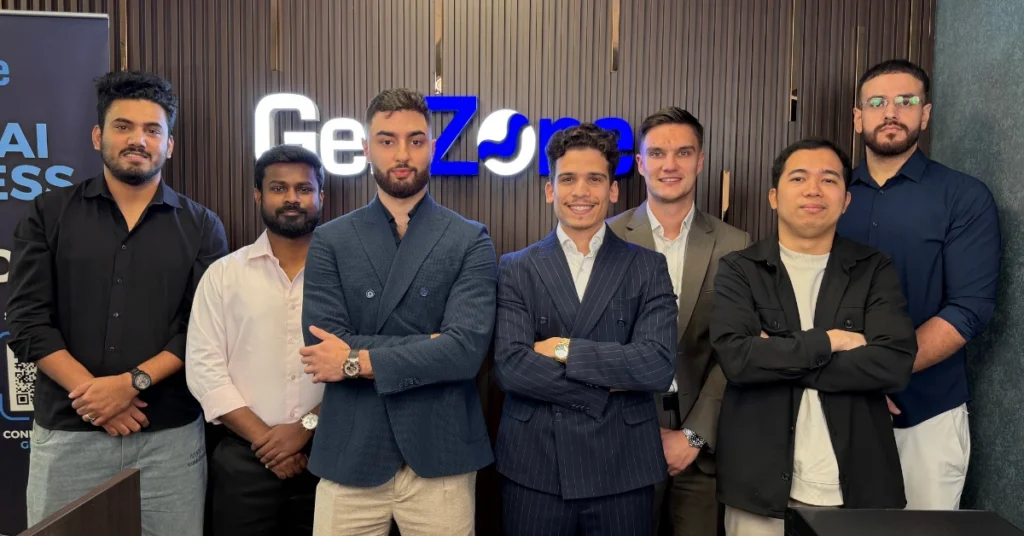
If you’re running a Dubai Free Zone company and global payment processing is part of your business – or you’re planning to set up in Dubai and want to think about the full structure from the start – GenZone is the team to build it with.
We’ve formed 1,000+ companies across both jurisdictions. We’re a Dubai Free Zone company based in Business Bay that has opened its own US LLC – so when we walk you through this structure, it’s not theoretical. We handle both sides of the setup under one roof, so nothing gets lost between providers.