






Executive Summary: A Dubai Free Zone setup and a US LLC solve different problems. The Free Zone gives UAE residency and 0% personal income tax, with 9% corporate tax on qualifying profits since 2023. A US LLC gives Stripe, USD banking and US platform access, usually with no US federal income tax but a mandatory Form 5472 filing carrying a 25,000 USD penalty. Many founders need both. GenZone builds both structures under one roof.
A Dubai Free Zone company and a US LLC come up a lot when founders plan an international business, and it helps to be clear on what each one is for. A Dubai Free Zone setup is about where you base your business and life: your trade licence, UAE residency and your tax position. A US LLC is about how your business plugs into the US financial system: Stripe, US banking, USD invoicing and access to US platforms.
This article walks through what each structure actually gives you, where they work well together, and how to decide which one fits your situation, or whether you need both. When you are ready for the mechanics of forming a US LLC, our step-by-step process guide covers costs, states, EIN and banking in full.
They Are Not Two Sides of the Same Coin
The most important thing to understand before comparing these two structures is that they are not really alternatives. They solve different problems.
A Dubai setup is a decision about where you base your life and business: your legal home, your residency, and your tax position.
A US LLC formed by a non-US resident is a decision about commercial infrastructure: how your business interacts with the US financial system, regardless of where you live.
Many founders end up needing both, for completely different reasons. Held together, they can make a real difference to how effectively you run and grow the business.
What a Dubai Free Zone Setup Actually Gives You
At its core, a Dubai setup is the scaffolding around a relocation. It includes:
- A UAE-registered company with a trade licence covering your business activities
- 100% foreign ownership with no local sponsor required
- A 2-year renewable UAE residency visa and Emirates ID
- Corporate banking access in a well-regulated, internationally respected financial centre
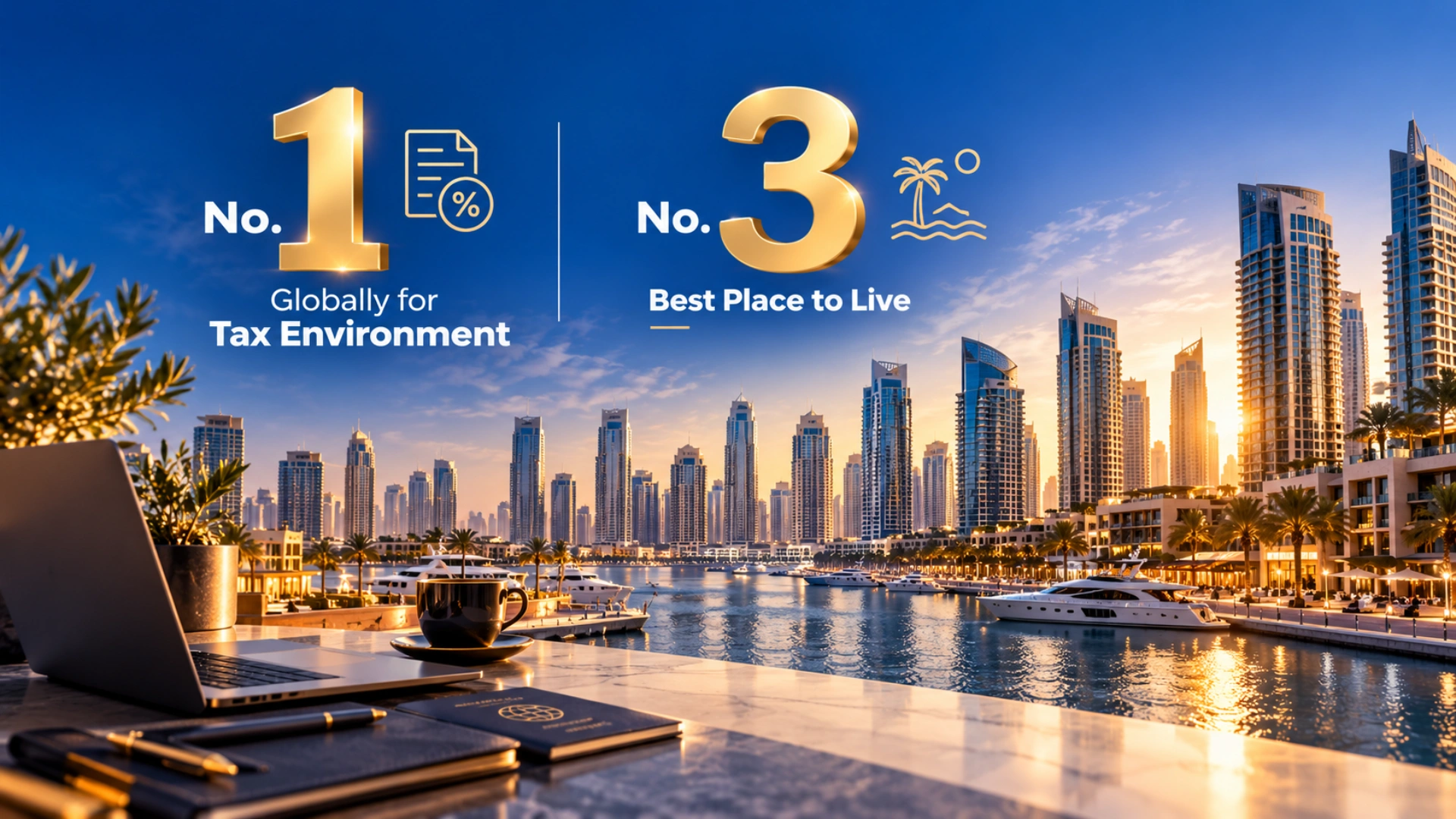
- 0% corporate tax on qualifying Free Zone income and 0% personal income tax
The tax numbers are the headline. For a founder paying 45 to 50% combined tax in the UK or Canada, they are hard to ignore. But tax alone is rarely what keeps people in Dubai.
What matters more over time is that Dubai works as a serious base for running a business: reliable infrastructure, English as the operational language, a timezone that bridges Europe and Asia, and a dense community of internationally minded founders and investors.
On residency specifically, the 2-year visa is a genuine UAE residency, not a mailbox address or a nominee arrangement. It lets you live there, open personal bank accounts, access healthcare and sponsor family. For founders thinking longer term, the UAE Golden Visa extends this to a 10-year renewable residency through qualifying routes including property or business activity.
A few honest caveats:
- Setup and annual maintenance costs are real. The financial case scales with revenue and is less compelling at low revenue levels.
- Qualifying for the 0% Free Zone rate requires meeting specific conditions. The UAE introduced a 9% corporate tax in 2023, and not all income automatically qualifies for the exemption. You can check your position with our QFZP eligibility checker.
- This decision requires genuine engagement with UAE residency. It does not work well as a purely nominal arrangement.
What a US LLC Actually Gives You
The starting point for most US LLC enquiries is not a lifestyle question. It is usually a practical problem that has already surfaced.
| Situation | What the US LLC solves |
|---|---|
| Stripe keeps declining payments from a non-US entity | Operating as a domestic US merchant improves approval rates and reduces friction |
| US affiliate networks only pay to US bank accounts | A US LLC with a US bank account unlocks those payouts |
| Amazon US, TikTok Shop or Shopify Payments restrict non-US entities | A US-registered entity removes or reduces that friction |
| US clients prefer or require a US entity on invoices | The LLC provides a recognisable, trusted business identity |
| You need USD banking rails | A US LLC with an EIN opens access to real US business bank accounts |
None of this requires moving to the US, becoming a US tax resident, or changing anything about your personal life. It is a commercial infrastructure decision.
On the tax side, a foreign-owned LLC with no US physical presence generally owes no US federal income tax on its business profits. But annual compliance is not optional: Form 5472 and a pro forma 1120 are required every year, whether or not any tax is owed, and the penalty for missing them starts at 25,000 USD. Our in-house CPAs handle these filings for clients, so nothing is missed.
One misconception worth addressing directly: a US LLC does not sit outside UAE tax rules simply because it is a US entity. If you are based in Dubai and managing the LLC from there, UAE corporate tax rules can treat it as having a permanent establishment in the UAE. The LLC is a commercial tool. It does not reduce what you owe under UAE rules, and it should not be set up with that expectation.
When Founders End Up With Both
The strongest case for running both structures together looks like this. A founder relocates to Dubai, or is planning to. Their business sells primarily to US or European customers online.
The Dubai Free Zone setup handles residency, UAE banking and the tax-efficient base. But the business relies on Stripe, sells on Amazon, or works with US affiliate networks, and the Free Zone company alone hits friction at that commercial layer.
The US LLC sits in front as the payment-facing entity. Conceptually, the structure runs like this:
You (UAE resident) own your UAE Free Zone company, which owns your US LLC.
Payments from US customers flow into the US LLC. Profits distribute up to the UAE company. Tax liability sits at the UAE level. The US LLC files its annual compliance forms but typically generates no US tax bill.
A few things matter for this to work: the LLC should be owned by the UAE entity rather than by you personally, annual US filings cannot be skipped even with zero tax owed, and where management and control of the LLC sits affects the UAE corporate tax position.
We cover why founders choose this structure, and how the ownership and money flow work in detail, in the Dubai Free Zone plus US LLC dual structure guide.
How to Decide Which One You Need
Rather than a checklist, start from the problem you are actually trying to solve.
A Dubai Free Zone setup tends to make sense when:
- Your home country tax rate is taking a significant share of your income and you want a lower-tax base
- You want to physically relocate, or at minimum establish genuine non-residency
- Your business operates internationally and does not depend on local clients at home
- Your revenue clearly justifies the setup and ongoing costs
A US LLC tends to make sense when:
- You keep running into payment processing friction as a non-US entity
- Your business depends on US platforms, US affiliate networks or US banking rails
- US clients or partners expect a US business entity
- You need a US commercial identity without relocating
Both together tends to make sense when:
- You are based in Dubai and revenue comes primarily from US or global digital customers
- You need a tax-efficient home base and frictionless US commercial access
- You want UAE banking and US banking running in parallel for redundancy
- You already have a Dubai company and are hitting a wall on US platforms
Ready to Act on Either One
If you have decided you need a US LLC, the next step is the mechanics, and we have a full walkthrough: How to Start a US LLC From the UAE covers the process, real costs in AED and USD, which state to choose, getting your EIN without an SSN, and opening US banking from the UAE.
If a Dubai setup is the priority, our Dubai company formation service handles the trade licence, residency visa, Emirates ID and UAE banking end to end.
And if the answer is both, that is what we are built for. GenZone is a Dubai Free Zone company, based in Business Bay, that opened its own US LLC, and we build both sides of the structure under one roof. For US LLCs we form in Wyoming or Delaware, whichever genuinely fits your business, and every formation is backed by a 100% money-back guarantee.
You can start and track the entire process on the GenZone LaunchPad platform, or book a free Dubai or US LLC call and we will map the right structure before you commit to anything.
Final Thoughts
This is not an argument that Dubai is right for every founder, or that every founder needs a US LLC. The costs are real, and each structure only pays off once it is solving a problem you actually have.
What both share is that neither runs itself: both require genuine ongoing compliance and proper oversight. These two structures solve different problems, and the smartest thing any founder can do is honestly identify which of those problems is theirs.