





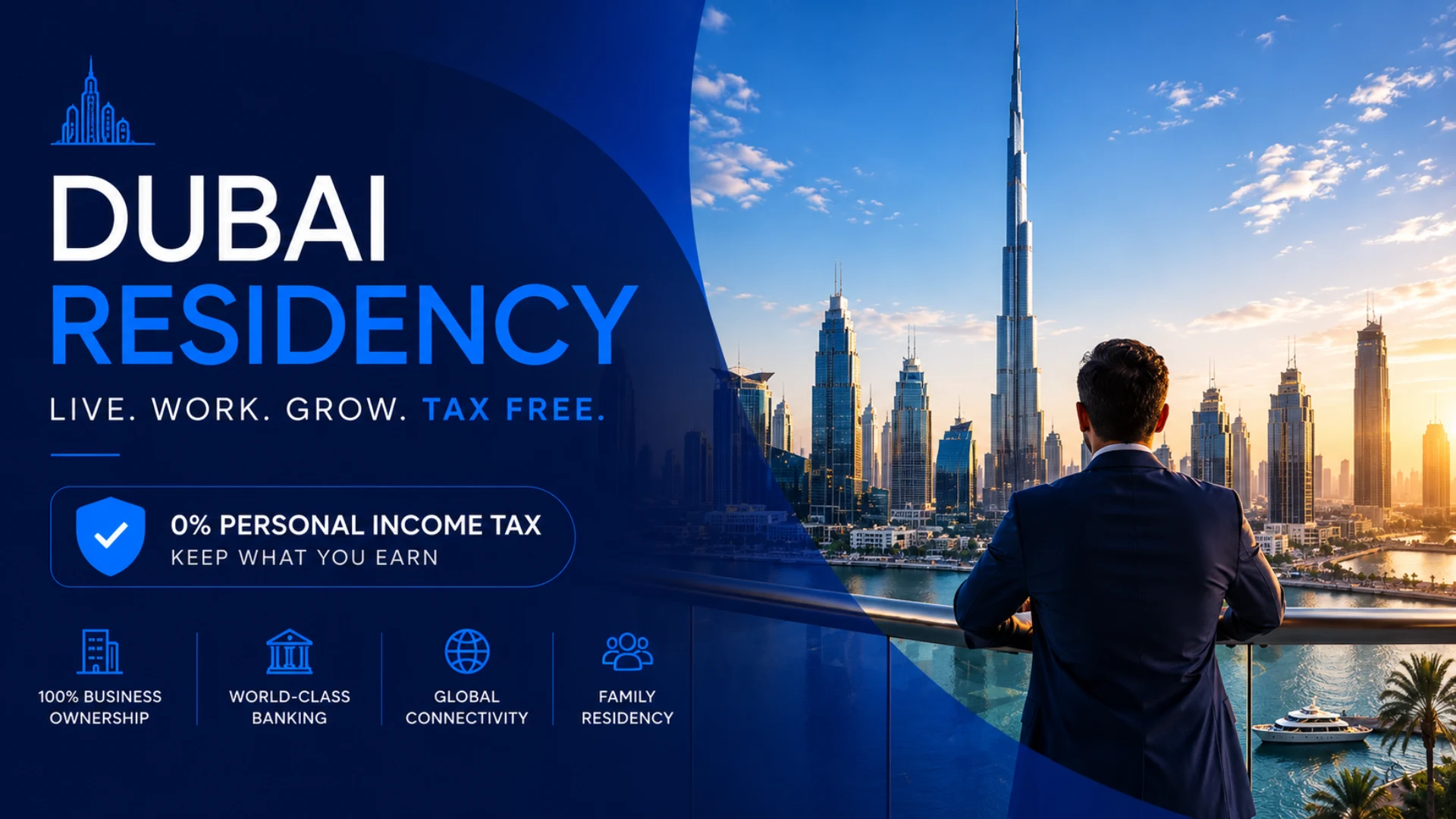
Executive Summary: UAE residency is obtainable through four pathways: a company you own, a Golden Visa via property investment of AED 2,000,000 or more, a two-year investor visa from AED 750,000, or an employment contract. The company route takes 7 to 10 days from arrival. This guide covers each pathway in full, including free zone vs mainland, banking and which accounts to open, neighborhoods, schools, healthcare costs, and how to maintain your visa and Tax Residency Certificate long-term.
Most guides about Dubai residency focus almost entirely on the tax angle and stop there. This one starts where those leave off.
You have probably already read about the 0% personal income tax and decided it is worth exploring. What you need now is the practical guide: which visa pathway actually fits your situation, what the process looks like day by day, how banking works and which banks to choose, where in Dubai people like you tend to live, what schools cost, what healthcare looks like, and what you need to do to keep your residency valid once you have it.
That is what this guide covers.
For the full breakdown of how Dubai’s 0% tax works and what you need to qualify, read 0% Tax in Dubai: The Complete Blueprint. For the precise day-count rules and how to manage your time across multiple countries, read How Long Do You Need to Stay in Dubai to Pay 0% Tax. This guide is about everything that comes after: building your actual life here.
Dubai Residency: The Practical Guide to Getting Set Up and Building Your Life Here
Pathways, banking, neighbourhoods, schools, healthcare, and what your first two weeks actually look like.
- No property purchase required
- Company registers in 3 to 5 days remotely
- Full setup in 7 to 10 days from arrival
- Sponsor family under same company
- AED 2,000,000+ in completed property
- Mortgage available, 20% down payment
- No annual company licence required
- Sponsor parents and siblings too
- AED 750,000+ in UAE property
- Lower entry than Golden Visa
- Tie residency to investment, no company
- Good option if purchasing anyway
- Sponsored by a UAE-registered employer
- Dependent on your employment contract
- Handled by employer HR team
- GenZone does not manage this route
What a UAE Residency Visa Actually Is
A UAE residency visa is a formal legal status issued by the UAE government that gives you the right to live and work in the UAE indefinitely, within the visa’s renewal cycle. It is not a tourist visa, not a digital nomad permit, and not a short-stay authorisation. It is equivalent in substance to a long-term residency visa in any other country.
With a valid UAE residency visa, you can:
- Live and work in the UAE without any time restriction within your visa period
- Hold an Emirates ID, your primary UAE government-issued identity document
- Open personal and business bank accounts as a resident, not a non-resident visitor
- Sign property leases and utility contracts in your name
- Access UAE healthcare as a resident
- Enrol children in UAE schools
- Sponsor your spouse, children, and in certain cases your parents, for their own UAE residency visas
- Travel in and out of the UAE without restriction on frequency or duration of absence
The visa is stamped in your passport and linked to your Emirates ID. Both documents work together as your proof of UAE residence.
The Four Main Pathways to UAE Residency
There is no single route to UAE residency. The right pathway depends on your situation, your plans, and how much capital you want to commit upfront. Here is an honest breakdown of all four.
Pathway 1: Company setup visa (most popular)
You register a company in the UAE, and that company sponsors you for a 2-year renewable residency visa. This is the route the majority of GenZone clients take, and for good reason: it requires no property purchase, no employer, and no capital commitment beyond the company setup costs. You are entirely in control.
The company can be either a free zone company or a mainland company. The choice between them matters and we cover it in depth below.
Who it suits: entrepreneurs, consultants, remote workers, agency owners, coaches, investors, digital business founders, and anyone who wants to run their own business from Dubai.
Visa validity: 2 years, renewable. Renewal requires that your company licence remains active and in good standing.
Visa allocations: depending on the free zone package and office space you choose, your company can hold multiple visa allocations, meaning you can also sponsor employees or family members under the same company structure.
How long it takes: company registration is completed remotely in 3 to 5 business days. From arrival in Dubai, the full process, including medical, biometrics, visa stamping, Emirates ID, and bank account, typically takes 7 to 10 business days.
What it costs: free zone company setup ranges from approximately AED 12,000 to AED 20,000 for the first year depending on the free zone, activity, and number of visa allocations. Annual renewal costs typically run AED 10,000 to AED 18,000. Full cost breakdown here.
Pathway 2: Golden Visa via property investment (10-year residency)
If you purchase UAE real estate worth AED 2,000,000 or more, you qualify for a 10-year Golden Visa, the most secure and longest-duration residency option available in the UAE. Unlike the company-based visa, the Golden Visa does not require annual licence renewals and is not tied to any business structure.
Who it suits: investors who want long-term residency security, buyers planning to hold Dubai property for capital appreciation or rental yield, and anyone who wants the simplicity of residency not linked to a company they need to maintain.
Visa validity: 10 years, renewable.
Minimum investment: AED 2,000,000 in completed (ready) property. Off-plan property can qualify but only once the purchase price paid reaches AED 2,000,000, not just the total contract value.
Mortgage eligibility: you can use a mortgage to finance the property. The down payment was recently reduced to 20%, meaning you can finance up to 80% and still qualify for the Golden Visa, provided the equity portion already paid reaches the AED 2,000,000 threshold.
Family sponsorship: the Golden Visa allows you to sponsor your spouse, children, parents, and in some cases dependent siblings, more generous than the standard company-based visa.
No annual renewal costs: once granted, the Golden Visa does not require a company licence or any business entity to maintain. The primary ongoing cost is the property itself and any associated service charges.
For the full picture on how to use Dubai real estate to get residency, including off-plan vs ready property considerations and the smart sequencing most investors use, read our dedicated Golden Visa guide.
Pathway 3: Two-year investor visa via property
A property purchase of AED 750,000 or more qualifies you for a 2-year renewable investor visa. This is distinct from the Golden Visa in duration and in family sponsorship scope, but it is a valid and cost-effective route for buyers who want residency without committing to the full AED 2,000,000 threshold.
Worth knowing: Dubai recently dropped the property minimum for its 2-year investor visa, making this pathway more accessible than it previously was. If you are planning a property purchase in any case, this can be an efficient way to tie residency to your investment rather than maintaining a separate company structure.
Pathway 4: Employment visa
If you are relocating to work for a UAE-registered employer, your employer will sponsor your residency visa. This is a well-established and common route, but it is dependent on your employer rather than yourself. GenZone does not manage employment visas, as these are handled by HR and legal teams within the sponsoring company. If this is your situation, your employer should walk you through their standard onboarding process.
Free Zone vs Mainland: The Decision That Shapes Everything
If you are going the company route, the single most consequential decision you will make is whether to set up a free zone company or a mainland company. Here is what each one actually means in practice.
Free zone companies
Free zones are designated economic areas within the UAE that operate under their own licensing authority and regulatory framework. There are more than 40 free zones in the UAE, each with a different focus and different advantages.
The major benefits:
- 100% foreign ownership with no local partner or sponsor required
- 0% corporate tax on qualifying income and activities (see our tax guide for the qualifying conditions)
- 0% personal income tax for the company’s owner-resident
- Faster setup, typically 3 to 5 business days for licence issuance
- Streamlined bureaucracy compared to mainland licensing
The practical limitation: free zone companies are generally not permitted to trade directly with customers based on the UAE mainland without going through an approved distributor or a mainland entity. For businesses whose clients are primarily outside the UAE, this limitation is entirely irrelevant. For businesses that need to sell services or goods directly to UAE-based individuals or companies on the mainland, it is a constraint that needs to be addressed.
Which free zone is right for you depends on your specific business activity, your budget, and how many visa allocations you need. GenZone works with all major free zones and will recommend the right one for your situation. Common choices include IFZA, Meydan, DMCC, DIFC, and Dubai South, each with different strengths and pricing.
Mainland companies
A mainland company is licensed directly by the Department of Economic Development (DED) and can operate freely anywhere in the UAE without geographic restriction.
The major benefits:
- No restriction on trading with UAE mainland clients
- Eligibility for UAE government contracts and public tenders
- A wider range of licensable business activities
- Full physical presence anywhere in the UAE, from Deira to Dubai Hills
On ownership: the UAE reformed its Commercial Companies Law to allow 100% foreign ownership across most mainland activities. The old requirement for a 51% UAE national partner was removed for the vast majority of business types. There are some regulated sectors, legal services, banking, and certain healthcare activities, where local partnership requirements remain, but these are the exception rather than the rule.
On tax: mainland companies are subject to 9% corporate tax on net profit above AED 375,000 per year. UAE corporate tax is still the lowest rate in the world for this type of structure, but it is a distinction worth factoring into your structure decision.
The simple version: if your clients are outside the UAE and you run a service or digital business, a free zone company is almost certainly the right choice. If you need to operate a physical business serving UAE customers, or bid on government work, you need a mainland licence.
Banking in Dubai: What it Actually Looks Like
Banking is one of the most practical concerns for people relocating to Dubai, and also one where expectations and reality sometimes diverge. Here is the honest picture.
Opening a personal bank account
With a valid UAE residency visa and Emirates ID, opening a personal bank account is straightforward. Most banks allow you to open a current account, savings account, and multi-currency account within a single branch visit.
The major retail banks available to UAE residents include Emirates NBD, Abu Dhabi Commercial Bank (ADCB), Mashreq, First Abu Dhabi Bank (FAB), and RAKBANK. Each has its own account tiers, minimum balance requirements, and international transfer fees.
For residents who want a more flexible, digital-first experience, the online banks are worth knowing:
Wio Bank is the most popular among entrepreneurs and newer residents. It offers multi-currency accounts, instant virtual debit cards, fee-free transfers in some corridors, and a clean mobile-first interface. Full Wio Bank review here.
Mashreq Neo is Mashreq’s digital banking arm, offering competitive rates and a solid mobile experience.
Liv by Emirates NBD is a younger-oriented digital bank with competitive FX rates and a simple interface.
Comparison of the top 3 online banks in Dubai covers Wio, Mashreq Neo, and Liv X in detail if you want a side-by-side breakdown.
Opening a corporate bank account
A corporate bank account for your UAE company requires your company’s trade licence, memorandum of association, shareholder documents, and your personal Emirates ID and residency visa. Most banks process corporate account applications in 3 to 10 business days after receiving the complete documentation.
GenZone handles all corporate banking introductions and document preparation for clients. Are Dubai banks safe? covers the regulatory environment and why UAE banking is as secure as any major Western financial system.
Why banks reject applications
Corporate account rejections do happen, particularly for businesses in certain sectors or for founders from certain nationalities. The most common reasons include incomplete documentation, business activities that the bank flags as higher risk (crypto, trading, certain professional services), and weak economic substance in the company.
Why Dubai banks reject business accounts, and how to get approved covers this in detail, including the preparation steps that dramatically improve approval rates.
Sending and receiving international payments
UAE banks support SWIFT international transfers and are well integrated into global payment networks. Many residents use a combination of their UAE bank account and services like Wise or Payoneer for specific transfer corridors.
For businesses in crypto or digital assets, Dubai banks have made crypto trading significantly more accessible in recent years. Cashing out crypto in Dubai is covered in its own guide for those whose income includes digital assets.
Where to Live in Dubai: Neighbourhoods for Relocating Entrepreneurs
Dubai is a large, spread-out city and the neighbourhood you choose significantly affects your daily life. Here is where most relocating entrepreneurs and professionals end up and why.
Business Bay
Business Bay is the central hub for professionals and entrepreneurs. It sits immediately next to Downtown Dubai and the Burj Khalifa, with excellent transport links, a dense concentration of restaurants and cafes, and a working-professional energy that many people find motivating. GenZone’s own offices are in Business Bay.
Rents: expect AED 80,000 to AED 140,000 per year for a 1 to 2 bedroom apartment. Higher floors and canal-facing units command a premium.
Best for: solo founders and couples who want to be close to the action, have easy access to clients and meetings, and prefer a walkable urban environment.
Dubai Marina and JBR
Dubai Marina is one of the most popular residential areas for Western expats. It is waterfront, walkable, and has an extremely active social scene with hundreds of restaurants, bars, gyms, and beach access at JBR (Jumeirah Beach Residence) a short walk away.
Rents: AED 75,000 to AED 150,000 per year for a 1 to 2 bedroom, depending on floor and view.
Best for: people who prioritise lifestyle, proximity to the beach, and a social, international community. Also very popular with couples and young professionals.
Palm Jumeirah
The Palm is the premium address in Dubai. Private beach access, villa-style living, and a more exclusive atmosphere than the Marina. It appeals to high-net-worth individuals and families who want space and quiet alongside the luxury infrastructure.
Rents: AED 200,000 to AED 600,000+ per year for villas and larger apartments. Studio and 1-bedroom units exist but the Palm is predominantly a family and premium market.
Best for: people who want the prestige address, have families who would benefit from the private school options nearby, and want space.
Jumeirah Village Circle (JVC)
JVC is significantly more affordable than the above options and has improved substantially in terms of amenities and connectivity over the past few years. It is popular with families who need more space for the budget and with professionals who do not need to be centrally located.
Rents: AED 45,000 to AED 85,000 per year for a 1 to 2 bedroom apartment. Family villa-style units from AED 100,000.
Best for: families on a controlled budget, people who work from home and do not need central access, and those prioritising space over location.
Downtown Dubai
Downtown is the prestige urban core, home to the Burj Khalifa, the Dubai Mall, and some of the most recognisable skyline views in the world. It is denser and slightly less practical for day-to-day errands than the Marina, but the address carries significant weight.
Rents: AED 90,000 to AED 200,000+ for 1 to 2 bedroom apartments depending on view and building.
Best for: high earners who want a trophy address, people who entertain clients frequently, and those who value prestige proximity to landmarks.

Healthcare in Dubai
Dubai has a well-developed private healthcare system. Public healthcare is available primarily to UAE nationals. Residents rely on private health insurance, which is mandatory in Dubai for visa holders.
Health insurance for a single adult in good health typically costs AED 4,000 to AED 12,000 per year depending on coverage level and your age and health history. Comprehensive family plans covering two adults and two children range from AED 15,000 to AED 40,000 per year.
When setting up your company, many free zone packages include basic health insurance coverage as part of the initial setup. GenZone will clarify exactly what is included in any package we recommend.
Major private hospitals include Mediclinic, Cleveland Clinic Abu Dhabi, American Hospital Dubai, King’s College Hospital Dubai, and Emirates Hospital. Standards are high, wait times are short compared to most public systems, and English is widely spoken across the healthcare system.
For anything requiring specialist treatment or complex procedures, Dubai’s best private hospitals are genuinely world-class. Many people who have used both UK or Australian public health systems and Dubai’s private system find the Dubai experience considerably faster and more personal.
Schools in Dubai
If you are moving with children, schooling is one of the most important practical decisions you will make. Dubai has an excellent range of international schools covering British, American, IB, French, German, and other curricula.
The British curriculum (GCSE and A-Level or IGCSE) is the most widely available and the most popular among UK, Australian, and South African expats. Schools following British curriculum include Jumeirah English Speaking School (JESS), Dubai British School, and Repton Dubai.
The American curriculum (AP and IB) is popular with North American families and those with university ambitions in the US. Dubai American Academy and GEMS World Academy are well-regarded options.
The International Baccalaureate (IB) is offered as a standalone curriculum at several schools and as a pathway alongside other curricula at others. It is highly regarded for university applications globally.
School fees range considerably depending on the school and year group: from approximately AED 25,000 per year for younger year groups at mid-tier schools, to AED 80,000 to AED 100,000+ per year at the most prestigious international institutions. Waiting lists at popular schools can be significant, particularly for mid-year enrollments.
The practical advice: research schools before you arrive and apply early, ideally 3 to 6 months before your intended start date. Do not assume a place will be available at the school of your choice.
Maintaining Your UAE Residency
Getting your residency visa is the start, not the end. Here is what you need to do to keep it valid.
Annual company licence renewal
If your residency is tied to a company you own, that company’s trade licence must be renewed every year. If the licence lapses, your visa is at risk of cancellation. GenZone manages annual renewals for all clients who use our ongoing compliance service, with reminders and processing handled before deadlines.
Visa renewal every two years
Your residency visa is valid for 2 years (or 10 years if you hold a Golden Visa). Renewal requires your company licence to be current and in good standing, and involves repeating the medical and biometrics process. GenZone handles this renewal process for clients on ongoing packages.
The 6-month absence rule
If you leave the UAE and do not return for 6 consecutive months, your residency visa can be automatically cancelled. This is the rule that catches many people off guard. If you need to be outside the UAE for an extended period, there are ways to apply for an absence permit that preserves your visa status. Make sure this is on your radar before any long trip.
Emirates ID renewal
Your Emirates ID expires at the same time as your residency visa. Both are renewed simultaneously during the visa renewal process.
Tax Residency Certificate maintenance
Your Tax Residency Certificate must be renewed annually through the Federal Tax Authority. This requires that you continue meeting the minimum physical presence requirement. Full details on how the TRC process works and the day-count requirements.
What the First Two Weeks in Dubai Actually Look Like
To make this concrete, here is what a typical GenZone client’s first two weeks look like from arrival.
Saturday: Arrive in Dubai. Check into accommodation. Settle in. GenZone has provided a pre-arrival checklist so you already know where you are going and what to bring.
Sunday: Rest and orientation. No appointments. Use the day to open a sim card (du or Etisalat, both widely available), explore your neighbourhood, and confirm Monday’s schedule with your GenZone contact.
Monday: Medical and biometrics appointment. A 15-minute combined appointment. Blood test, chest X-ray, fingerprints, and photograph. Done by mid-morning.
Tuesday to Wednesday: Waiting period. Medical results processing. Use this time to view rental apartments if you have not already secured accommodation, explore different neighbourhoods, or handle any personal admin.
Thursday: Residency visa issued. Your visa is stamped in your passport. The Emirates ID is in production.
Friday to Sunday: Weekend. Dubai’s weekend is Saturday and Sunday. Use this time to explore the city.
Monday of week 2: Emirates ID arrives. With your ID in hand, you visit your bank of choice to open a personal account. This is usually completed the same day.
Tuesday to Wednesday: Corporate bank account application submitted. Documents submitted, application in process.
End of week 2: Fully set up. Company registered. Visa in passport. Emirates ID in hand. Personal bank account open. Corporate account in process (typically finalised within 3 to 7 working days of submission).
How GenZone Manages This for You

GenZone is a platinum-tier partner with Dubai’s leading free zones. That means faster processing, preferential pricing, and direct escalation channels when anything needs to move quickly. More than 1,100 founders across 50 countries have gone through this process with us.
What we handle: company registration, visa application, medical appointment scheduling, biometrics coordination, Emirates ID collection, personal and corporate banking introductions, and ongoing renewals.
What our clients get: a dedicated advisor who knows their situation, a clear timeline with no surprises, and a single point of contact for every step of the process.
Book a free strategy call to talk through your specific situation. There is no obligation and no sales pressure: just a clear conversation about what the process looks like for someone in your position and whether it makes sense for you.
Frequently Asked Questions
Can I get Dubai residency without buying property?
Yes. The company setup route requires no property purchase. You register a company and it sponsors your visa. Most GenZone clients use this route.
Can I bring my family?
Yes. As a UAE residency visa holder, you can sponsor your spouse and children for their own residency visas and Emirates IDs. The Golden Visa also allows sponsoring parents and dependent siblings.
Can I keep my home country bank accounts?
Yes, in most cases. UAE residency does not require you to close accounts elsewhere. Whether your home country’s tax authority expects you to report or close those accounts depends on your country of origin and your specific circumstances. Get advice from a home-country tax specialist.
What happens if my company gets cancelled?
If your company lapses, your residency visa linked to it is at risk. This is why GenZone’s annual renewal service matters: we handle the renewal before the deadline so this never becomes an issue.
Can I run my existing business through a UAE company?
Yes, this is exactly what most clients do. They restructure their existing business operations under a UAE free zone entity and invoice their clients through that company. Whether that is appropriate for your specific business and home country situation is worth discussing with a tax adviser, but it is a common and well-established approach.
How is Dubai different from other low-tax jurisdictions?
Unlike some offshore jurisdictions, Dubai is a real, functioning city you can genuinely live in. World-class infrastructure, excellent healthcare, strong schools, a thriving business community, and a growing tech ecosystem. The tax benefit is real, and so is the life you build around it.